YouTube Reused Content Policy 2026: What Changed and What to Check
YouTube says its reused content review of clips, compilations and reactions hasn't changed. Here's what is documented, what's rumor, and how to audit your videos.
In this article
YouTube's reused content policy covers content that is not clearly your own original creation, such as clips, compilations, reactions and commentary, and the official YouTube channel monetization policies page says there is no change to how it reviews those formats. The July 2025 switch from "repetitious" to "inauthentic content" is a separate, related update. Confirm the current text on that page before acting on any youtube reused content policy 2026 headline.
It applies to monetization in the YouTube Partner Program (YPP). It doesn't promise outcomes, and it doesn't promise earnings.
What is YouTube's reused content policy?
Reused content is content that isn't clearly your own original creation, and it can come from YouTube or from anywhere else. What matters is whether you add significant original value. A clip with real commentary, new editing and your own context is a different thing from a clip with a logo on it.
The rules for reused content boil down to one test: could a reviewer see what you made? Not what you found, not what you licensed. What you made.
What changed in 2025 and 2026 (and what did not)
Two things get blended in most summaries: an unchanged reused content review and a renamed policy. Keeping them apart removes most of the panic.
The official 'no change' statement on reused content
YouTube's own page is blunt about it:
"There is no change to our reused content policy which reviews content like commentary, clips, compilations, and reactions."
That's the primary source, and we'd rather quote it than paraphrase a video about it. The policy tests the same kind of content it always did. If your channel was fine under that test last year, nothing on the page says it fails now. If it was borderline, it's still borderline.
Repetitious content renamed inauthentic content (July 2025)
In July 2025 the YPP wording moved from "repetitious content" to "inauthentic content," aimed at mass-produced or repetitive uploads. It's the update most people mistake for a new reused content rule. It targets a different failure: videos that look templated and near-identical, whoever made them.
So if you're asking what the new YouTube policy in 2026 is, the documented answer is that the reused content review is unchanged, and the 2025 rename is the change to know about.
How to tell a real update from a rumor
A real update lives on the official policy page, with a last-updated date you can check yourself. Reddit threads, PDFs and explainer videos are secondhand, and some are just recycled thumbnails and fear.
We've watched creators rebuild a whole channel around a rumor that the page never said. Open the page, read the section, check the date. Five minutes.
Which channels are most exposed
Clip channels, compilation channels, reaction channels and mass-produced or templated channels are the most exposed. That includes AI voiceover Shorts and faceless channels that publish dozens of near-identical videos a week.
Faceless isn't the problem. Sameness is. A faceless channel with its own scripts, its own angle and visible editing choices looks nothing like a feed of swapped-footage clones. Channels with real commentary and edits sit at lower risk, but they still have to show that work on screen.
On AI specifically: the official page doesn't ban AI tools. It asks whether the result is original and non-repetitive. Our rule is simple. If a tool did all the work and you added nothing, so would any other uploader.
How to review your existing videos in 10 minutes
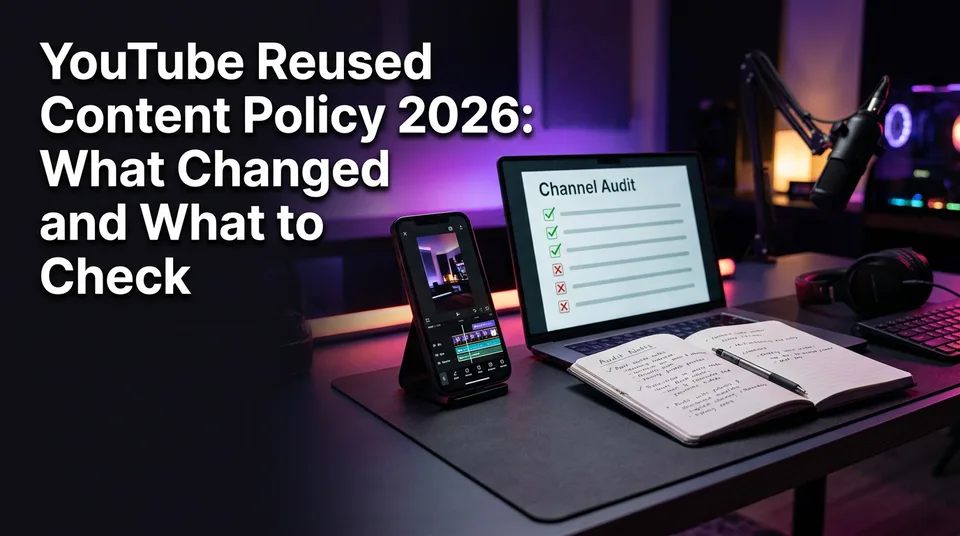
You can review a video in 10 minutes by splitting it into what's yours, what's borrowed, and what value you added. Do it for your 10 most-viewed videos first, then for the latest batch.
Questions to ask for each video
- What footage or audio is not mine?
- What did I add that a viewer couldn't get from the source?
- Would this video look nearly identical to my last five?
- Would a stranger understand my contribution in the first 10 seconds?
What original value looks like: commentary, new narration, editing, context
Original value is visible: your own commentary, narration you wrote, edits that change meaning or pacing, and context the source lacked. If you batch-produce Shorts, audit the pipeline step by step.
| Step | Passes when | Fails when |
|---|---|---|
| Source footage | Yours, or used briefly inside a larger argument | The main body is someone else's clip, unchanged |
| Script | You wrote the angle and the point | Copied or lightly reworded from the source |
| Voiceover | AI voice reads your own script | AI voice reads a transcript of the source |
| Captions | Support your narration | Only transcribe the original audio |
| Edit | Cuts, order and framing express a point of view | Trim and logo, nothing else |
If most rows fail, the video fails, whatever tool made it. In our own workflow, story voiceover, best-moment clipping and captions only help when the script and the angle are yours.
Why trying to 'bypass' reused content does not work
Mirroring, speeding up, cropping or pitch-shifting changes pixels, not value. A human reviewer sees through it, and so does a repetitive-pattern check across your uploads. We don't recommend it, and we won't write a how-to for it. The fix for reused content is making something more original, not disguising what's reused.
If a channel gets flagged
If a channel is flagged, fix the videos first, then appeal with evidence of the changes. Permission from the original creator doesn't by itself make content original for monetization. Reused content review is separate from copyright enforcement and Content ID, so a licence solves one problem and leaves the other open.
Start in YouTube Studio, read the exact reason given, and match it against the table above. Rework or remove the weakest videos, and keep before-and-after notes. Don't re-upload the same footage with a new title.
Caveat: confirm on the official policy page
Policies change, so the official YouTube page is the only source to trust for the YouTube Partner Program and for YouTube monetization rules in 2026. Summaries, PDFs and videos age quickly, including this one.
Nothing on the page ties a view count to a payout either. RPM and CPM vary by niche, audience and season, so a figure like $2000 a month can't be derived from views alone. Check the page's last-updated date before you change your workflow, and again after any news cycle.
Where to go next
- What Is Reused Content on YouTube? Meaning, Examples and What Counts as Original — the full definition, for anyone who needs the basics first.
- Reused Content Checker: How to Self-Audit a Video Before Posting — a deeper version of the 10-minute review.
- How to Fix a Reused Content Flag on YouTube — the next step if your channel is already flagged.
- Can You Monetize AI-Made or Faceless Shorts on YouTube? — covers the AI and faceless question in detail.
Generate your reel right now
Paste a link to any video — WowReveal writes the story, voices it and adds captions, a headline and music. Ready for Reels, Shorts and TikTok.
No link? Upload a file
- 30 free credits
- No card needed
- Voiceover in 9 languages
- Failed jobs refunded