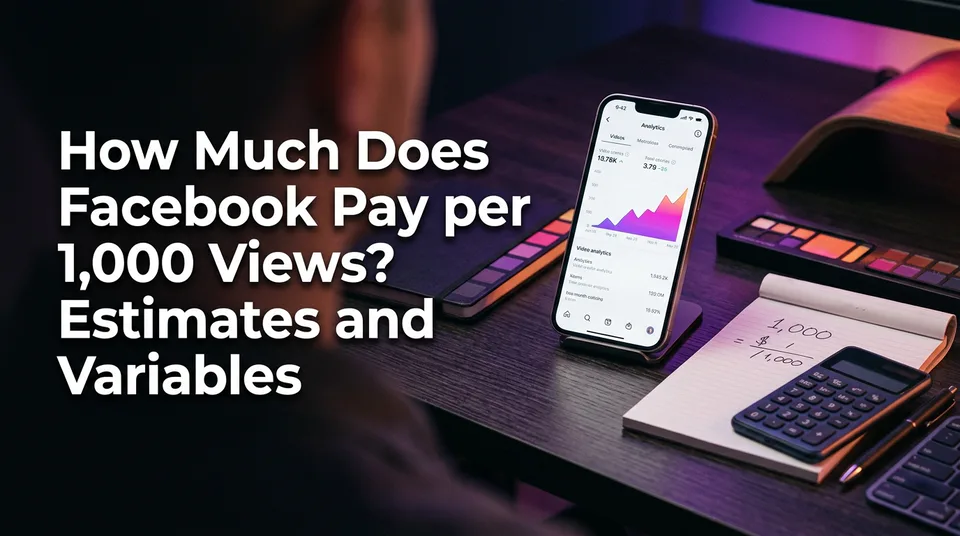
How Much Does Facebook Pay per 1,000 Views? Estimates and Variables
There's no fixed Facebook rate per 1,000 views. Here's what moves the number, how to calculate your own range from Insights, and what 10k, 50k and 1M views could look like.
How much does Facebook pay per 1000 views? There's no fixed rate. Payouts for Reels vary widely, and publicly reported figures run from a few cents to a few dollars per 1,000 monetized views. They depend on audience country, content type, watch time and ad demand, so the only reliable number is the one you calculate from your own page's Insights.
The short answer: there is no fixed rate per 1,000 views
Meta doesn't publish a per-1,000-views rate for Facebook Reels, so any single number you see online is someone else's result. Two pages with the same view count can earn very different amounts, and a page can even earn nothing on views that looked identical in the dashboard.
What the commonly reported ranges say (and why to treat them as anecdotal)
You'll see claims like $0.02-$0.20 per 1,000 views on Reels versus $2-$6 on longer video. They come from Reddit threads, YouTube screenshots and blog posts. Each reflects one page, one audience, one stretch of weeks.
We treat them as anecdotes. They're useful for sanity-checking your own math, not for planning a budget. Rules and payouts change, so check Meta's creator hub for current program details.
What changes the payout: four variables
Four things move your per-1,000 figure: where your viewers live, what kind of content you post, how long people actually watch, and how much advertisers are bidding. You control some of these more than others.
Audience country
Audience country is usually the biggest swing factor. Advertisers pay more to reach viewers in Tier 1 audience countries such as the US, so the same 100,000 monetized views can pay several times more from one geography than another. Facebook RPM (revenue per 1,000 monetized views) by country isn't published, but your Insights audience breakdown shows where your views come from.
Content type and length
Reels and longer videos monetize differently, and reported figures for longer video tend to run higher. That's the origin of the $2-$6 versus cents gap people quote, but it's anecdotal. Treat your own format split as data: if you post both, compare them separately.
Watch time and retention
Watch time is how long viewers actually stay, and retention is the share who make it to the end. A strong hook in the first 2-3 seconds and a clean story arc keep people watching. Reels that get swiped away fast generate less value than ones that hold attention.
Ad demand and season
Advertiser demand moves with the calendar. Ad budgets typically swell around the end-of-year holidays and drop in the quieter months, so your CPM (what advertisers pay per 1,000 ad impressions) and your RPM drift with them. A weak January doesn't mean your page got worse.
Total views are not paid views
Only monetized (qualified) views count toward earnings, so your total view count overstates the base. A Reel can pull 200,000 views and pay close to nothing if few of them qualified.
First, the page must be in Facebook Content Monetization, be eligible, and follow the originality rules. Reposted or unoriginal clips can lose eligibility or earn nothing. Second, not every view of an eligible Reel is monetized.
So how many views do you need to get paid? There's no magic view count. Eligibility has its own thresholds, which Meta changes from time to time, and views only earn once you're in the program. Likes and followers aren't paid directly either: 5,000 followers or 1,000 likes a day earns nothing by itself.
How to estimate your own range from your page data
Your per-1,000 estimate is earnings divided by monetized views, multiplied by 1,000. Pull both numbers from the Meta Professional Dashboard (Insights) for the same date range.
Here's a made-up example: $84 earned on 210,000 monetized views over 6 weeks. $84 ÷ 210,000 × 1,000 = $0.40 per 1,000. That's the page's estimated RPM for that window.
Do this properly:
- Use 4-8 weeks of data, not a single week or one viral Reel.
- Use monetized views, not total views, as the divisor.
- Repeat it every few weeks and keep three numbers: low, typical and high.
- Keep Reels and longer video in separate columns.
If you want to skip the spreadsheet, the free WowReveal Facebook earnings calculator does the same arithmetic. Any estimate is just that, and Meta decides what's paid.
What 10,000, 50,000 and 1 million views could look like
Scaling is multiplication: monetized views ÷ 1,000 × your per-1,000 rate. The rates below are assumptions, chosen to span the anecdotal range. They're not forecasts or promises.
Illustrative scaling table
| Monetized views | Low ($0.10) | Mid ($0.50) | High ($2.00) |
|---|---|---|---|
| 10,000 | $1 | $5 | $20 |
| 50,000 | $5 | $25 | $100 |
| 1,000,000 | $100 | $500 | $2,000 |
That answers the usual search questions. The payout for 10,000 views, 50k views or 1 million views depends on your own rate and on how many of those views were monetized. If only 40% of your 50,000 views qualified, apply the rate to 20,000.
What '$500 a day' would require
Reaching $500 a day means a very large number of monetized views every day. At an assumed $0.50 per 1,000, that's 1,000,000 monetized views daily. At $2.00, it's 250,000. At $0.10, it's 5,000,000.
This isn't a target we're handing you. It shows why screenshots of big daily payouts usually involve huge volume, high-value audiences, or both.
How to improve earnings per 1,000 views without chasing a number
Improving your per-1,000 figure comes down to four levers, and none of them is a trick. We've watched pages stall for weeks after relying on unoriginal reposts, so start there.
- Originality and policy safety. Original, transformed content keeps views eligible. Reposting other people's videos without permission puts monetization at risk.
- Retention. Tighten the hook, cut dead air, and use clear captions so viewers can follow without sound. Short, well-edited 9:16 clips (1080×1920) usually hold attention better than rambling ones.
- Audience geography. Check your Insights country split. Content that fits viewers in higher-value markets can lift your RPM, but don't force it.
- A consistent niche. A page that posts one type of content gets a predictable audience and cleaner data, which makes your low/typical/high range more reliable.
Tools help with the production side. WowReveal can write a story and voice it with AI voiceover, clip the best moments, and add animated captions and a cover, so more of your time goes into originality and testing hooks. Your per-1,000 number still comes from your own Insights.
Frequently asked questions
How much money is 1,000 views on Facebook Reels?
It depends on your page. Reported figures range from a few cents to a few dollars per 1,000 monetized views, and they're anecdotal. Divide your Insights earnings by monetized views and multiply by 1,000 to get your own estimate.
Does Facebook pay for 5,000 followers or 1,000 likes a day?
No. Followers and likes aren't paid directly. Earnings come from eligible, monetized views, and only if the page is in Facebook Content Monetization.
Why did my views earn almost nothing?
Usually because most of those views weren't monetized or qualified. Eligibility, originality problems and audience mix can all reduce the paid base, so check your monetized views, not just total views.
Where to go next
- What Is RPM for Creators, and How Is It Different From CPM? — defines the per-1,000 concept your estimate relies on.
- Why Facebook Says 'Criteria Not Met' for Content Monetization (and What to Check) — explains why views may not be monetized at all.
- How Many Followers Do You Need to Monetize Facebook Reels? — covers the eligibility side of getting paid.
- Facebook Reels vs YouTube Shorts vs TikTok: Where to Post to Earn — compares payouts per 1,000 views across platforms.
- How to Make Money on Facebook Reels: A Step-by-Step Path From New Page to Earning Page — the full path once you know your numbers.
Turn any video into a ready-to-post Reel
Paste a link — WowReveal writes the story, voices it in 9 languages and adds captions, a headline and music. Start with free credits, no card.
Start free →