What Is YouTube Shorts Revenue Sharing? How the Ad Pool Pays Creators
YouTube Shorts pays from a shared ad pool, not per video. Here's how the pool, the music deduction and your 45% share work, and why the same views can pay differently.
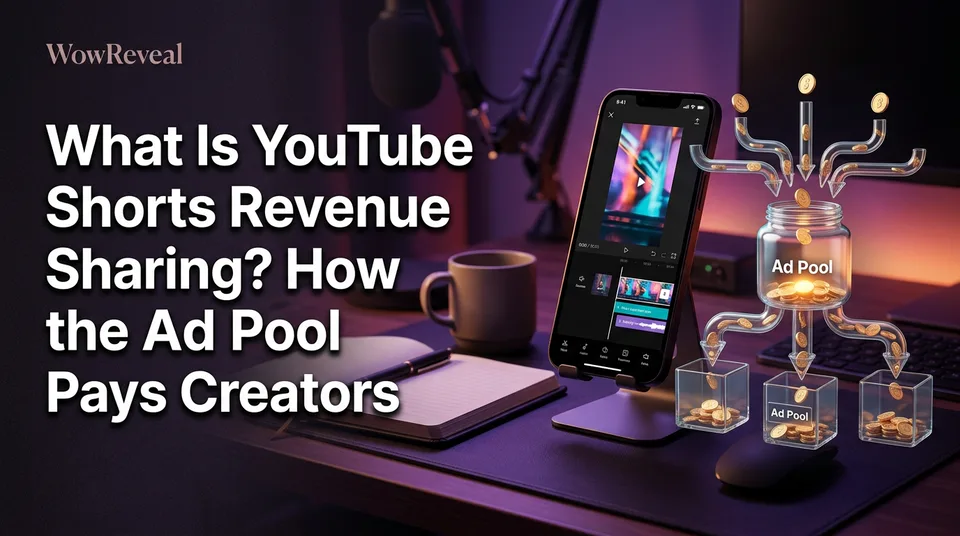
YouTube Shorts revenue sharing is the system where ad revenue from the Shorts Feed is pooled, music licensing costs are deducted, and the remaining creator pool is divided by each creator's share of eligible Shorts views, with the creator receiving 45% of their allocation. It is not a per-video ad split, and the rate is not fixed per view. That's why "how much do monetized Shorts make" has no single answer.
Key points
- Ads run between Shorts in the Shorts Feed, not on your individual video.
- Music licensing costs come out of the pool before creators are paid.
- Your slice depends on your share of all eligible Shorts views.
- You keep 45% of your allocation.
- Per-1,000-view earnings vary widely, so treat any fixed rate as an estimate.
Shorts revenue sharing in one paragraph
Shorts revenue sharing pays you from a common pot instead of from ads attached to your clip. Viewers swipe through the Shorts Feed, ads appear between videos, and that money is collected together. Your payout reflects how much of the total eligible viewing your Shorts attracted. Per YouTube Help's Shorts monetization policies, that's the core model. Rules change, so check the page before you plan around it.
How the Shorts ad revenue pool is calculated
The calculation runs in three steps: pool the Feed ad revenue, deduct music licensing, then divide by views share and apply 45%.
Step 1: Feed ad revenue is pooled
Every ad shown between Shorts in the Feed adds to one pool. Nobody's video "owns" an ad. A Short that gets swiped past in two seconds and one watched to the end both sit inside the same pot.
Step 2: Music licensing is deducted
Music licensing costs are covered at the pool level before the creator pool is formed. What remains is the creator pool. Your own Shorts don't need to use licensed music for this deduction to apply, because it happens upstream of your account.
Step 3: Views share sets your slice
Your allocation is your share of total eligible Shorts views in the period. You then receive 45% of that allocation. The other 55% is not a fee on you, it's accounted for in the pool's costs and YouTube's share.
Shorts revenue sharing vs long-form revenue sharing
Long-form pays a 55% creator share on ads that play on your own video, while Shorts pays 45% of a pooled allocation. That's the whole difference in percentage terms, but the mechanics differ more than the numbers. Long-form ties revenue to ads served on a specific video. Shorts ties it to your slice of the Feed.
Don't compare 55 and 45 and conclude long-form pays more per view. Different bases, different viewers, different ad formats. Compare actual RPM (revenue per 1,000 views) in your own account instead.
What affects how much monetized Shorts make
Your share of eligible views, the music licensing deduction, viewer country and ad demand all move the effective rate. The same view count can pay differently two months in a row.
Creator-reported figures for money per 1,000 views usually land in cents, not dollars. That's a pattern, not a promise. Audience location and niche shift it up or down.
Here's the scale problem, as pure arithmetic. At an invented rate of 5 cents per 1,000 views, 1 million views is $50. Reaching $2,000 a month at that rate would take 40 million. At 30,000 views the same rate gives $1.50. Your rate will differ, but the math shows why the "$3,000 or $10,000 a month" claims need massive view counts or a much better rate.
We've watched creators chase view counts and ignore which audiences those views came from. Retention and viewer country decide more than volume alone.
Who can earn: Partner Program basics
You must be in the YouTube Partner Program to earn from Shorts, and subscribers do matter. The lower tier starts at 500 subscribers. The full ads tier requires 1,000 subscribers plus either 10 million valid public Shorts views in 90 days or 4,000 watch hours, per the YouTube Partner Program eligibility page. Thresholds can change, so verify them there.
So can you earn from Shorts without subscribers? Not through ads. Without the subscriber minimum you aren't in the program at all.
Where to check the official numbers
Use YouTube Help for the rules and YouTube Studio analytics for your actual revenue. Help documents the pool, the 45% and the eligibility tiers. Studio shows your estimated revenue and RPM for real Shorts, which beats any outside guess.
Be careful with any "revenue sharing calculator" online. It can only plug an assumed rate into your view count. That's a rough sketch, not your payout. After a month or two of monetized data, your own Studio numbers are the calculator.
Where to go next
- What Is RPM for Creators, and How Is It Different From CPM? — the metric you'll read in YouTube Studio to see what your Shorts actually earn.
- Monetization-Safe Shorts: A Pre-Publish Checklist for Every Reel and Short — keeps the monetization described here from being put at risk.
- Are AI Story Videos Allowed on Facebook and YouTube? — the next question if you make Shorts with AI voiceover.
- Facebook Reels vs YouTube Shorts vs TikTok: Where to Post to Earn — compares the Shorts pool model with other platforms' payouts.
- How to Find Trending Reels and Spot Formats Before They Peak — helps you grow your share of views in the first place.
- AI Video Generator for Shorts: When to Use Images, When to Use Video
- AI Short Video Creation for Reels and Shorts: The Complete Guide
- YouTube Shorts Monetization Requirements: Who Is Eligible and How to Check
Turn any video into a ready-to-post Reel
Paste a link — WowReveal writes the story, voices it in 9 languages and adds captions, a headline and music. Start with free credits, no card.
Start free →