Hooks for Reels and Shorts: How to Win the First 3 Seconds
A good hook shows the payoff in 3 seconds. Here are four hook types, timing rules, niche examples and the mistakes to avoid on Reels, Shorts and TikTok.
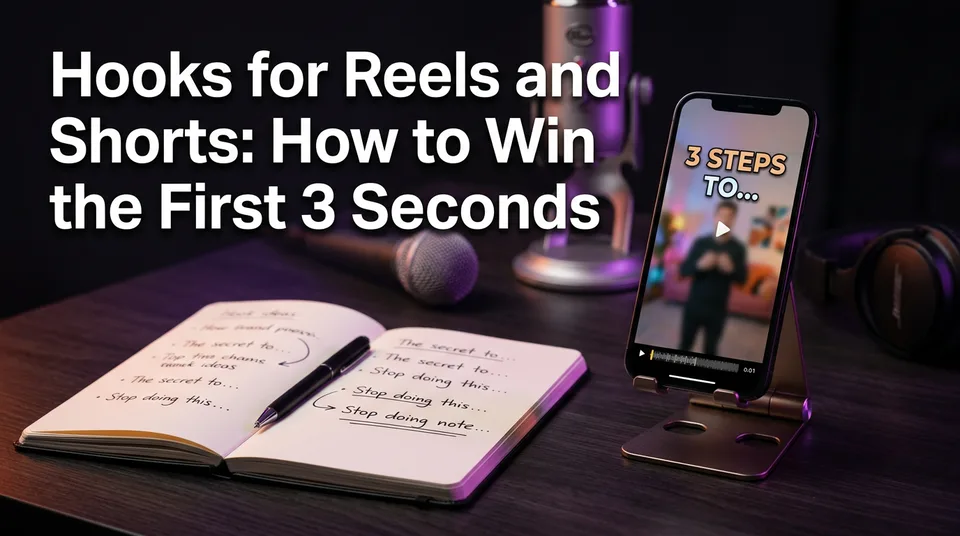
A strong Reels or Shorts hook shows or says the payoff, the problem or the surprise within the first 1-3 seconds, and it almost always falls into one of four types: question, outcome-first, curiosity gap or conflict. If you're asking how to increase your reel views, this is the cheapest lever you have, because viewers who leave at second 2 never reach the rest of your video. Below you'll find reels hook ideas by niche, a timing guide, and the mistakes that quietly kill reach.
Key takeaways
- A hook has three layers: the visual, the on-screen text and the spoken line. The best ones use all three, saying one idea.
- The four types that work: question, outcome-first, curiosity gap and conflict. Pick by niche, not by mood.
- Working timing guideline: the visual lands in 0-1 seconds, the text and voice by 3 seconds, and the promise is clear by about 5 seconds.
- Every hook must be paid off inside the video. Misleading hooks hurt completion and can put monetization at risk.
- Test with your own data: same video, three hooks, then compare 3-second hold and completion.
What a hook is and why the first 3 seconds decide the view
A hook is whatever stops the thumb in the first moments and gives the viewer a reason to stay for the next five seconds. That's it. It isn't a greeting, a logo sting or a clever title card.
The reason it matters is simple. Feeds on Instagram Reels, Facebook Reels, YouTube Shorts and TikTok let people swipe in a fraction of a second, so you're competing with the next video instantly. Instagram's own creator hub pushes the same basic advice: grab attention early and keep the video tight. If you post daily, a weak hook doesn't cost you one video. It costs you the habit of every video.
The three layers: visual, text and spoken hook
The visual hook is what the eye sees at frame one: the injured puppy, the shaggy haircut, the pan hitting oil. The text hook is the on-screen line, usually 4-8 words. The spoken hook is the first sentence of the voiceover or the first sound.
The mistake we see most is stacking three different ideas. The picture shows a rescue, the text says "Wait for it," and the voice starts with "Hi everyone." Nothing connects. When all three layers point at one idea, the viewer understands in under a second.
Sound-off viewers only get the first two layers. So build the video so it makes sense with the voice muted.
How the hook affects hold rate and completion
Hold rate is the share of viewers who are still watching after the first few seconds. Completion rate is the share who reach the end. A hook mostly moves the first number, but the second follows.
Why? Viewers who stay because of a clear promise tend to watch longer, because they want the promise delivered. Viewers who stay out of confusion leave at second 8. You can see both on your retention graph: a sharp cliff early means a weak or misleading hook, a slow slope means the middle is the problem.
YouTube explains how to read this in its help page on audience retention reports. Meta shows similar retention data in Meta Insights and Meta Business Suite. Metric names and layouts change, so check what your account displays today.
The 4 hook types that work on Reels and Shorts
The four hook types that work are question, outcome-first, curiosity gap and conflict, and each fits certain content better than others. Choose the one that matches what your video actually delivers.
| Hook type | What it does | Best for | Example line |
|---|---|---|---|
| Question | Makes the viewer answer in their head | Stories, tips, podcast clips | "Would you give a stray dog your last meal?" |
| Outcome-first | Shows the result before the process | Transformations, restorations | "This rusty knife became this in 40 seconds." |
| Curiosity gap | States something that needs explaining | Stories, rescues, facts | "He ignored the box for three days. Then it moved." |
| Conflict | Opens on tension or disagreement | Talent shows, sports, podcasts | "The judges laughed. Then she opened her mouth." |
Question hooks
A question hook asks something the viewer can't help answering. Use it when the video is a story, a tip or a debate, where the answer unfolds over the next 20-40 seconds.
Good ones are specific and personal: "Would you have stopped for this dog?", "Why does nobody tell new moms this?", "Can a 9-year-old really sing like this?" Weak ones are vague: "Want to see something cool?"
Avoid yes/no questions that the viewer can answer with a swipe.
Outcome-first hooks
An outcome-first hook shows the finished result in the first second, then rewinds. It's the backbone of transformation, restoration and recipe formats because the payoff is the most attractive frame you have.
Lines that work: "From matted to magazine-ready.", "This 1950s radio was dead. Watch.", "The final plate first, then how it's made." You can pair it with a quick flash of the end result and then a cut back to the start.
Here the video must really show the process. If the "after" is edited or from another source, you've crossed into misleading territory.
Curiosity-gap hooks
A curiosity gap opens a question the viewer wants closed, without telling them the answer. "The farmer found something in the well" works because the brain wants the ending.
The gap has to be real. Hide the outcome, not the topic. "You won't believe what happened" is empty. "The vet looked at the X-ray and went quiet" is a gap with a picture in it.
Use this for story Reels, rescues and facts. Pay it off before the final 5 seconds, or at least by the end, and be honest about what the answer is.
Conflict hooks
A conflict hook starts at the moment of tension: a disagreement, a doubt, a risk, an underdog. "Everyone told her to quit. Listen to this." Tension gives the viewer a side to pick.
It suits talent shows, sports moments and podcast clips, where someone is doubted, challenged or corrected. Keep it truthful. Inventing a fight the clip doesn't contain is the fastest way to a disappointed viewer, and a disappointed viewer is a lost viewer.
How many seconds you have: a hook timing guide
You have roughly 3 seconds to land the hook and about 5 seconds to make the promise clear. This is a working guideline from watching retention graphs, not a platform rule, and your audience may behave differently.
| Window | What must land | Layer |
|---|---|---|
| 0-1 s | Something visually specific is happening | Visual |
| 1-3 s | The reason to stay is stated | Text and spoken line |
| By 5 s | The viewer knows what they'll get | All three |
0-1 second: the visual
The first frame is your thumbnail, your opener and your pitch at once. Open in the middle of the action: the dog in the drain, the clippers touching the hair, the pan on fire. No fade-ins, no black frames, no establishing shot of a building.
If your source clip starts slowly, trim it. An AI Clipper that finds the strongest moment helps here, because the best frame is often 20 seconds into a long video, not at the start.
1-3 seconds: the text and spoken line
Within the next two seconds, the on-screen text appears and the voice says one short sentence. Both should say the same idea in different words, not repeat each other word for word.
Example: text reads "She waited 3 days for this," voice says "Nobody expected the dog to come back." Same story, two angles. Keep the spoken line under about 10 words so it finishes before the 3-second mark.
By 5 seconds: the promise is clear
By second 5, the viewer should be able to finish this sentence: "I'm watching this to see _." If they can't, they leave. This is where many curiosity-gap videos fail, because they hide so much that viewers don't know what they're waiting for.
Ask a friend to watch the first 5 seconds and tell you what the video is about. If they hesitate, rewrite.
Catchy hook examples by niche
Catchy reels hook ideas work best when they're written for the niche's actual payoff, so here are lines by format that you can adapt, not copy blindly. Change the details to match your real footage.
Animal rescue and wholesome stories
Rescue pages win with emotion plus stakes. Use a question or a curiosity gap.
- "He'd been tied to this fence for 11 days."
- "Would you have walked past this puppy?"
- "The whole street ignored her. Then one man stopped."
- "Watch what the kitten does when he's finally warm."
For wholesome kindness stories, outcome-first also works: "Look at his face when he sees the keys."
Haircut and restoration transformations
Transformations are the natural home of outcome-first. Flash the result, then rewind.
- "From 6 years of rust to showroom shine."
- "Nobody thought this hair could be saved."
- "Wait for the reveal at the end of this cut."
- "This table was headed for the trash. Now look."
Our experience with before-and-after formats is that the final reveal should also be the opening frame, then cut back to the messy start.
Talent shows and kids' talent
Conflict is the strongest here: doubt, then proof.
- "The judges rolled their eyes. Then she hit that note."
- "He's 8. Listen to the second line."
- "She walked on stage with no shoes and a borrowed guitar."
Keep these true to the clip. If the judges didn't actually roll their eyes, don't say they did.
Street food and sports moments
Street food loves sensory visuals and quick outcomes. Sports loves tension and last-second turns.
- "One vendor. 300 plates a day. Watch his hands."
- "This is how a 2-dollar noodle bowl is made."
- "Down by 2 with 3 seconds left."
- "Nobody saw this play coming."
Podcast clips and best moments
Podcast clips need a spoken claim or a conflict in the first line, since the visual is often just people talking.
- "He said the one thing guests never admit."
- "Why most founders lie about this number."
- "She disagreed, and the host stopped."
Pick the sharpest sentence from the clip, put it on screen as text, and start the audio on it. Skip the host's intro.
Funny hooks for Reels
Funny hooks work by setting a wrong expectation and breaking it fast.
- "I tried to look professional. The cat had other plans."
- "My mom's reaction to the thing I've been hiding."
- "POV: you said 'one more video' 4 hours ago."
Humor depends on timing. If the joke needs 6 seconds of setup, it's not a hook, it's a risk.
Text hooks on Reels: on-screen wording, placement and length
A text hook is a short on-screen line, usually 4-8 words, placed where the platform's interface won't cover it. It does the work for sound-off viewers and reinforces the voice for everyone else.
Word count, font size and safe zones
Keep the text to one or two lines. Use a bold, high-contrast font large enough to read on a small phone at arm's length. If you need to squint on your own screen, it's too small.
Stay inside the safe zone of the 9:16 frame (1080×1920). The platform's username, caption and buttons cover parts of the top and bottom, and the right edge on some apps. A rule that works: keep text in the central area, away from the bottom 20% and the right edge. Check each platform's preview, because interface layouts change.
Animated captions help here too, but the hook line should be static or appear instantly. Don't make viewers wait for a word-by-word animation to get the point.
Text hook formulas you can copy
These formulas are starting points. Fill in your real details.
- Number + stakes: "3 days. No food. One dog."
- Outcome + time: "From rusty to new in 40 seconds"
- Doubt + proof: "They laughed. Then she sang."
- Direct question: "Would you have helped?"
- Warning: "Don't skip the ending"
The last one is weak on its own, so use it only when the ending truly delivers.
Hook mistakes that cost you views
The mistakes that cost the most views are slow intros, hooks the video never pays off, misleading claims and text that's too small or too late. Most are fixable in the edit.
Slow intros, logos and greetings
"Hey guys, welcome back to my channel" burns 2 seconds of a 3-second budget. So does a 1.5-second logo animation. Move your brand to a watermark or the end and start on the action.
Clickbait with no payoff
A hook is a promise. If you say "wait for the twist" and there's no twist, viewers feel cheated, and your retention graph shows it: a spike of early viewers, then a drop in the final third. Over time you train your audience to distrust your hooks.
Before posting, ask: if a stranger watched this to the end, would they say the hook was honest?
Hooks that mislead and risk monetization
Misleading hooks aren't only a retention problem. Platform monetization programs, including Facebook content monetization and the YouTube Partner Program, have rules about spam, deception and originality, and these rules change. Read the current policies on each platform's official help pages.
A practical rule: the hook may tease, but it can't lie. Don't claim an outcome the video doesn't show, don't use a cover image from a different scene, and don't present old footage as new events.
Unreadable or late text
Text that appears at second 3 is a caption, not a hook. Text in a thin font over a busy background is invisible. Text that sits under the interface buttons never gets read.
Also check the mismatch between cover and opening. If the cover shows one scene and the first frame shows another, the viewer feels disoriented.
Hooks for Reels vs Shorts vs TikTok: what changes
The core hook rules are the same across Instagram Reels, YouTube Shorts and TikTok, but sound habits, looping and text placement differ slightly. Treat these as tendencies and check your own analytics.
- Instagram Reels and Facebook Reels: Many viewers watch with sound on, but the feed is mixed, so keep text readable. Visual and outcome-first hooks work well on both. Keep text clear of the bottom caption area.
- YouTube Shorts: Shorts often loop, so a final line that flows back into the first frame can raise rewatches. The first frame also acts as the preview in some placements, so make it strong.
- TikTok: Viewers expect fast, native-feeling openings. Spoken hooks and direct questions are common, and heavy production looks out of place. Keep text away from the right-side buttons.
If you post the same video to all four, adjust the text position once for the safest overall zone rather than editing four versions.
How to create and test hooks faster with AI
You can create hook candidates quickly by writing the story first, then pulling three possible openings from its first lines, and then testing them against your own retention data. AI helps with volume, but you decide what's true.
Turn the first line of a story script into a hook
If you make AI-voiced story Reels, the script's first sentence is your spoken hook. Use this template: [Subject] + [unexpected detail or stake] + [time or number].
- Weak: "This is a story about a dog."
- Better: "A dog sat outside a locked gate for 11 days."
Then split it. The spoken line is the full sentence. The text hook is the shortened version: "11 days at a locked gate." The visual is the gate and the dog.
A script writer tool and AI voiceover (text-to-speech) save time here, since you can generate several opening lines and hear them before choosing. In WowReveal, story voiceover, the AI Clipper, animated captions and niche templates all work at this stage, but the thinking about what's honest and specific is still yours.
A simple test: same video, 3 hooks, compare 3-second hold and completion
Here's a process that doesn't need a data team.
- Pick one video that already performs near average for your page.
- Make three versions that differ only in the hook: for example a question, an outcome-first and a curiosity gap.
- Post them on separate days at similar times, or use a platform's testing feature if available.
- After 48-72 hours, open Meta Insights or YouTube Analytics and compare the 3-second hold (or the early retention) and the completion rate.
- Keep the winning type for that niche and test a new variation next week.
Don't trust a single result. One video is noise, five videos start to be a pattern. And don't expect a benchmark number from us, because it varies by niche, audience and platform. Your own baseline is the only one that counts.
Frequently asked questions
What are some catchy hooks for Reels?
Catchy hooks are specific and match the video's payoff. Examples: "He waited 11 days at this gate" (curiosity gap), "From rusty to new in 40 seconds" (outcome-first), "The judges laughed. Then she sang" (conflict), "Would you have stopped for this dog?" (question). Adapt the details to your real footage.
How do I write a good hook for a reel?
Start with the strongest moment of the video, say it in under 10 words, and show it in the first frame. Then make sure the visual, the on-screen text and the spoken line all point at the same idea. Finally, check that the video actually delivers on it.
How long should a hook be?
Aim to land the visual in about 1 second, the text and spoken line by 3 seconds, and a clear promise by about 5 seconds. This is a working guideline, not a platform rule. Your own retention graph will tell you where viewers leave.
Can a hook hurt my monetization?
A misleading hook can. If the video doesn't deliver what the hook promises, viewers leave and platforms may treat it as deceptive. Platform rules change, so check the current policies for Facebook content monetization, the YouTube Partner Program and TikTok, and keep every hook truthful.
Do I need different hooks for Reels, Shorts and TikTok?
The hook types are the same, but text placement and sound habits differ. Keep text away from interface buttons, make the video understandable with sound off, and test which hook type works best on each platform using its own analytics.
Where to go next
- How to Make Reels Go Viral: The Practical Guide — the broader growth picture around the hook.
- Best Reel Length and Pacing for Completion Rate — what to do after the hook to keep viewers to the end.
- How to Find Trending Reels and Spot Formats Before They Peak — find formats to pair with these hook types.
- AI Short Video Creation for Reels and Shorts: The Complete Guide — produce hook-first videos faster with AI.
- Niche Templates for Reels: Repeatable Formats for Daily Posting — reuse one hook structure across daily posts.
- Satisfying Restoration and Haircut Transformation Reels: A Before-and-After Format That Holds Attention — a deeper look at outcome-first hooks.
- Monetization-Safe Shorts: A Pre-Publish Checklist for Every Reel and Short — check that every hook is honest before you post.
- Facebook Reels vs YouTube Shorts vs TikTok: Where to Post to Earn — decide which platform deserves your best hooks.
- How to Make Your Reels Go Viral on Facebook: Signals, Tactics and Fixes
- Post Kit for Reels and Shorts: How to Write Titles, Descriptions and Hashtags
- What Is a Faceless Channel? Meaning, Examples and Monetization
- How to Write a Short-Video Script with AI (Hook, Body, Payoff)
Turn any video into a ready-to-post Reel
Paste a link — WowReveal writes the story, voices it in 9 languages and adds captions, a headline and music. Start with free credits, no card.
Start free →