What Is a Faceless Channel? Meaning, Examples and Monetization
A faceless channel never shows the creator on camera. Here's what that means, what it doesn't mean, and whether faceless Shorts and Reels can earn.
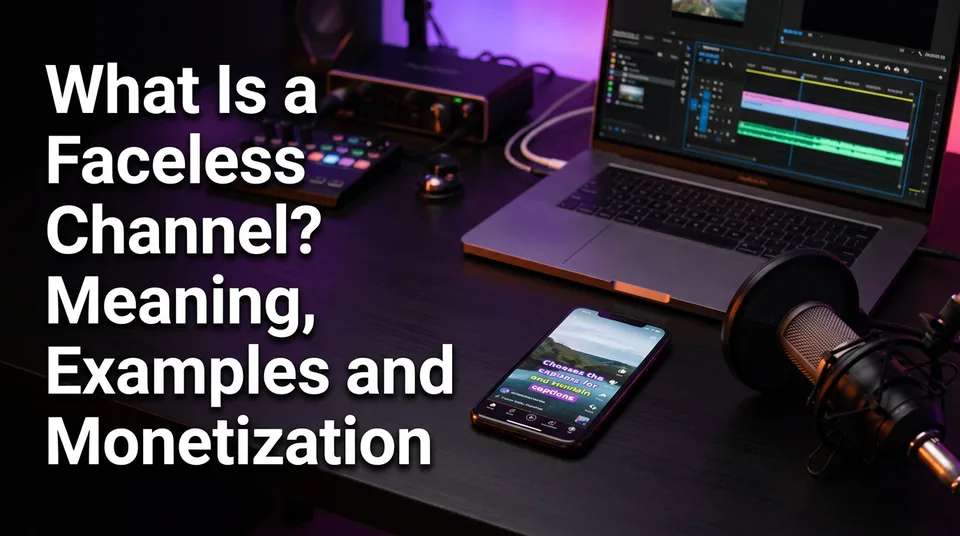
A faceless channel is a YouTube, Facebook, TikTok or Instagram channel or page where the creator never appears on camera, and the video is carried by voiceover, footage, text or AI visuals. That's the faceless YouTube Shorts meaning in one line. Faceless channels can be monetized if they meet the usual rules, because platforms judge the content, not whether you show your face.
Key points
- Faceless means the creator isn't on screen. It doesn't mean unnamed.
- It works on YouTube Shorts, Facebook Reels, TikTok and Instagram Reels.
- Voiceover, footage, captions and AI visuals do the job a face would do.
- Monetization depends on eligibility and originality, not on being faceless or not.
- No income is guaranteed, whatever the format.
Faceless channel: the definition
A faceless channel is one where the viewer never sees the person behind it. The video holds attention through something else: a narrated story, a clip with a strong hook, big animated captions, or generated images.
Plenty of people say "faceless YouTuber" or "faceless reels" for the same idea. Same thing, different platform label.
Faceless vs talking head vs anonymous
Faceless is a format choice, anonymous is an identity choice, and the two are independent. A talking-head channel puts the creator on camera. A faceless one doesn't. An anonymous channel hides who runs it, but you can run a faceless channel under your real name and a business page.
AI avatars sit in between. A synthetic presenter is still a face on screen, so most people file it separately from true faceless video. And faceless doesn't automatically mean AI-generated or reused. A creator who films their own hands cooking is faceless and fully original.
Common faceless channel examples
Most faceless channels fall into a few repeatable formats, and the niche matters less than how original your execution is. Facts, street food and sports moments all work. Here are the three we see most.
Narrated stories
An AI voiceover (text-to-speech) tells a short story over visuals. The script and pacing are the product. Strong hooks in the first 2 seconds matter more than the voice itself.
Compilations
Several clips are edited together around one theme. This is where reused content policy trouble starts, so you need real editing, commentary or permission for every clip.
Animal and satisfying content
Rescues, restorations and cleaning clips need almost no narration. Music, a headline and captions carry them. Again, the footage has to be yours or properly licensed.
How faceless videos are made
"Faceless YouTube automation" means a production workflow, not a way around the rules. You write or generate a script, add an AI voiceover, pick footage you own or have rights to, layer animated captions, and export in 9:16 (1080×1920). Tools like AI Studio can generate images or video when you have no footage.
We've watched pages lose reach for weeks after pushing mass-produced, near-identical videos. Speed is fine. Sameness isn't. Our step-by-step build guide, linked below, covers the full process.
Do faceless channels get paid?
Yes, faceless channels are allowed to monetize and are held to the same eligibility rules as everyone else. On YouTube, the YouTube Partner Program sets the thresholds. At the time of writing, ad revenue sharing requires 1,000 subscribers plus either 4,000 public watch hours or 10 million public Shorts views in 90 days. These rules change, so check the official page.
The real gate is originality. YouTube's channel monetization policies cover reused and repetitive content, and a faceless channel built on other people's clips can be refused. Facebook content monetization has its own eligibility checks through Meta, and TikTok has its own too.
So do people make money from faceless YouTube? Some do. Payout depends on views, eligibility, country and content quality, and nobody can promise a number. Are faceless reels worth it? If you like producing consistently and your content is original, they're a low-friction way to test a niche. Treat them as a business experiment, not a shortcut.
Where to go next
- Faceless Shorts with AI: How to Make Them Step by Step — The natural next step if you want to build your first faceless video.
- YouTube Shorts Monetization Requirements: Who Is Eligible and How to Check — The actual eligibility rules that apply to faceless channels.
- Reused Content Policies Compared: Facebook, YouTube and TikTok — The originality rules that still apply to every faceless format.
- Are AI Story Videos Allowed on Facebook and YouTube? — Whether AI-narrated faceless formats are permitted.
- What Is YouTube Shorts Revenue Sharing? How the Ad Pool Pays Creators — How faceless Shorts creators are actually paid.
- AI Video Generator for Shorts: When to Use Images, When to Use Video — Choosing AI visuals when you have no footage.
- Monetization-Safe Shorts: A Pre-Publish Checklist for Every Reel and Short — Quick checks before you post a faceless video.
- How to Write a Short-Video Script with AI (Hook, Body, Payoff)
Turn any video into a ready-to-post Reel
Paste a link — WowReveal writes the story, voices it in 9 languages and adds captions, a headline and music. Start with free credits, no card.
Start free →