What Is the 7-Second Rule on YouTube Shorts?
The "7 second rule" on YouTube is not one official rule. Here are the two meanings that matter for Shorts, how to build your opening, and what to check before you publish.
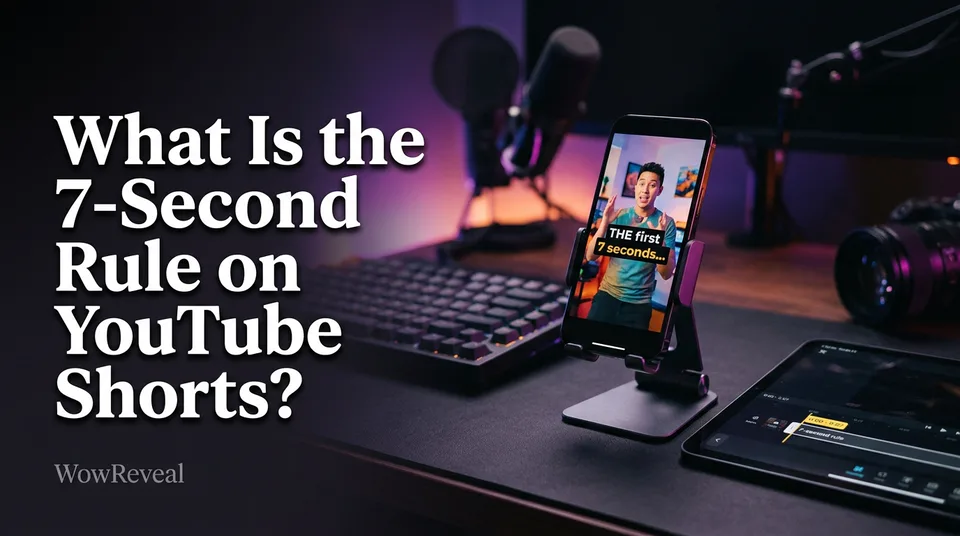
The 7 second rule on YouTube is not a single official rule. It usually means either a creator rule of thumb that the first few seconds decide whether people keep watching, or YouTube's advertiser-friendly guideline about language in the first 7 seconds. For YouTube Shorts, the retention version matters most, because viewers can swipe away instantly and your opening decides whether the rest of the video gets seen at all.
What people mean by the 7-second rule on YouTube
Three different ideas share this name, and only two of them are about YouTube. Search results mix them together, which is why the phrase feels so vague.
Meaning 1: the retention heuristic for the opening
This is a creator rule of thumb: the opening seconds decide whether a viewer stays or leaves. It rests on experience, not on a YouTube policy. Open the audience retention graph on almost any video and the steepest drop usually sits at the very start.
Nobody at YouTube has published a "7 seconds" threshold for retention. Treat it as a useful habit, not a law.
Meaning 2: the first-7-seconds language guideline for ads
The second meaning comes from the YouTube advertiser-friendly content guidelines, which have treated profanity in the opening seconds differently from profanity later in a video. This is the version behind the Reddit threads about swearing.
Here's the catch: that wording has changed more than once, and old details float around as if they were current. Read the YouTube Help page on advertiser-friendly content for the present rules. Platform rules change, so check it again every few months.
Not this: the self-help "7-second rule"
There's also a self-help "7-second rule" about controlling your reactions or making a first impression on people. It has nothing to do with video. If a result talks about meetings or other people's opinions, you're in the wrong place.
Why the first seconds matter more on Shorts
Shorts punish a slow start harder than long videos do, because the next video is one swipe away. A long-form viewer has chosen your video from a thumbnail and title. A Shorts viewer was simply handed it.
So the "7 seconds" shrinks. Most Shorts creators talk about a 3 second hook rule instead: the hook has to land in roughly 1 to 3 seconds, and a second beat, the proof or the promise of a payoff, should arrive by second 7. It's the same idea, compressed for a faster feed.
Swipe-away rate and the viewed-vs-swiped signal
In YouTube Studio analytics, Shorts show a viewed vs swiped away split. That's your swipe-away rate in plain form: of the people shown the Short, how many stayed and how many left immediately.
Watch it next to the retention graph. We've seen Shorts with a strong middle die because the first second was a logo or a "hey guys". Compare openings across your own Shorts instead of trusting any rule.
How to structure a 7-second opening
A workable opening has two beats: a hook in seconds 0 to 3, then proof or context in seconds 3 to 7. Anything before the hook is dead weight.
Seconds 0-3: the hook
Start on a promise, a question or a striking visual. The payoff moment, the surprising result or the strangest frame is often the best first shot. Don't open with a greeting, a logo or setup.
Seconds 3-7: the proof or context
Give the viewer a reason to stay. Show a piece of evidence, name the stakes, or make clear what happens next. The viewer should think "I need to see how this ends" by second 7.
Captions and the on-screen headline in the first frame
Many people watch with the sound low, so put a headline and animated captions on screen from the first frame. A silent viewer who can read the hook is still a viewer. If you build Shorts in WowReveal, the AI Clipper can find the strongest moment to lead with, and captions plus a headline are added automatically in the 9:16 render. You still decide whether the opening earns the swipe.
Check your first 7 seconds before you publish
Before publishing, read or listen to your first 7 seconds once, on purpose, with ad-suitability in mind. It takes 10 seconds and it's where wording problems are cheapest to fix.
What to verify in YouTube's advertiser-friendly guidelines
- Open the current guideline page and read the section on inappropriate language, because the treatment of the opening seconds has changed over time.
- Check the spoken audio, the captions and the on-screen headline, not just the voiceover or original audio.
- Remember what a problem looks like: a video can get limited ads (the yellow icon) in YouTube Studio, which reduces or removes ad revenue on that video.
- Keep in mind that earning from Shorts at all depends on the YouTube Partner Program, and YouTube decides eligibility, not you.
Following this check doesn't guarantee full ads or any earnings. It just removes an avoidable cause of limited ads.
It's a heuristic, not a platform rule
The retention version is a habit, not a policy, and following it guarantees nothing. No opening formula promises views, ad revenue or monetization.
What it does give you is something to test. Change the first 3 seconds, post, and compare the viewed-vs-swiped number against your last few Shorts.
Does the same idea apply on TikTok and Reels?
Yes, as a general habit. TikTok and Facebook Reels are also swipe-driven feeds, so a fast hook helps there too. But the 7-second language guideline is YouTube-specific. Each platform has its own content rules, so check the one you're posting on.
Don't confuse it with the 8-minute mid-roll threshold
The "8 minute rule" is a different thing: it refers to mid-roll ad eligibility on long-form videos. It has nothing to do with how you open a Short.
Frequently asked questions
Is the 7 second rule an official YouTube rule?
No. The retention version is a creator rule of thumb, and the language version comes from YouTube's advertiser-friendly guidelines, whose wording has changed over time. Check the current Help Center page rather than relying on forum posts.
How long should a Shorts hook be?
Aim to land the hook in about 1 to 3 seconds and give the second beat, proof or the promise of a payoff, by second 7. Then compare your viewed-vs-swiped numbers across Shorts to see what actually works for your audience.
Can swearing in the first 7 seconds get a Short limited ads?
It depends on YouTube's current advertiser-friendly guidelines, which have changed before. Read the current wording and check your audio, captions and headline. YouTube makes the final call on ad status.
Where to go next
- Hooks for Reels and Shorts: How to Win the First 3 Seconds — Concrete hook formats you can apply to the opening seconds right away.
- How to Write a Short-Video Script with AI (Hook, Body, Payoff) — Turns the two-beat opening into a full hook, proof and payoff script.
- Monetization-Safe Shorts: A Pre-Publish Checklist for Every Reel and Short — A fuller pre-publish check that includes the language in your opening.
- YouTube Shorts Monetization Requirements: Who Is Eligible and How to Check — What must be in place before a Short can earn anything.
- Why Shorts Get Demonetized and How to Appeal — The next step if a Short gets limited ads or is demonetized.
Turn any video into a ready-to-post Reel
Paste a link — WowReveal writes the story, voices it in 9 languages and adds captions, a headline and music. Start with free credits, no card.
Start free →