Facebook Reels vs YouTube Shorts vs TikTok: Where to Post to Earn
No platform reliably pays the most for short videos. Compare Facebook Reels, YouTube Shorts and TikTok on access, payout model and effort, then pick your primary and secondary.
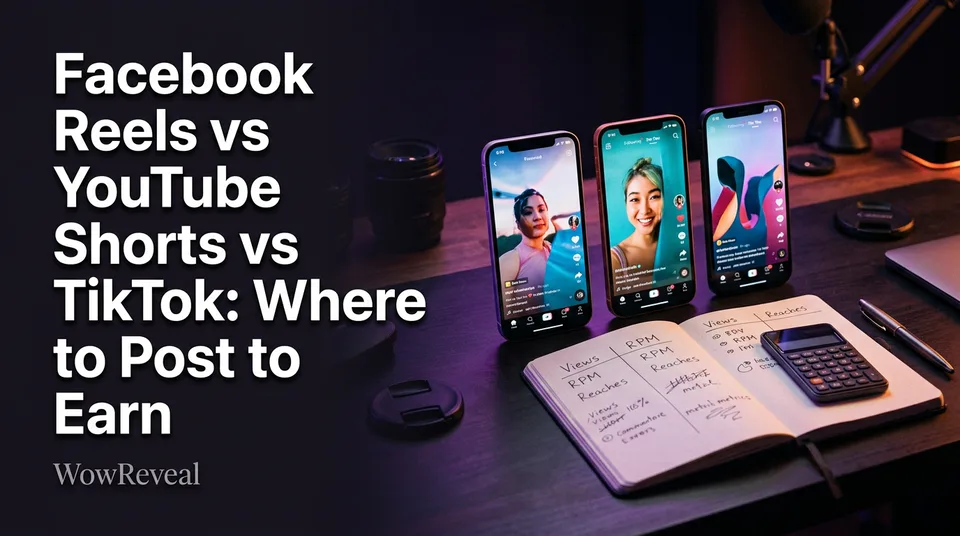
No platform reliably pays the most for short videos, and any facebook reels vs youtube shorts monetization ranking that claims otherwise is guessing. Payouts depend on eligibility, your audience's country and your content type. Facebook Reels and YouTube Shorts are generally the most accessible for small pages, while TikTok's program has stricter requirements. Below is a rule for picking one primary and one secondary platform.
Key takeaways
- No fixed winner on pay. The same view can be worth very different amounts depending on audience country and niche, so per-1,000-view claims from forums are not a basis for a decision.
- Access is the real first filter. YouTube publishes clear thresholds. Facebook's program is eligibility-based and can be invite-driven. TikTok's Creativity Program is the hardest to qualify for.
- Originality is the hidden cost. All three platforms penalize reused content, so the platform that fits your workflow is often the one you can keep original on every day.
- Pick one primary, one secondary. Post natively everywhere, but optimize and measure on a single platform for 30 days before you judge it.
- Measure your own RPM. Your analytics beat anyone's screenshot.
How Facebook, YouTube and TikTok pay for short videos
The three platforms use three different payout models, and that difference matters more than any headline rate. Facebook pays through performance-based programs, YouTube shares a pooled Shorts ad revenue, and TikTok pays for qualifying longer videos.
Facebook Reels: content monetization
Facebook content monetization is Meta's program for paying eligible creators for original content, including Reels. Payment is performance-based and tied to program rules that Meta has changed several times, with bonuses, ads and other formats coming and going. Check the Meta Business Help Center for the current setup in your country, because these rules shift.
YouTube Shorts: Partner Program revenue share
YouTube Shorts earns through the YouTube Partner Program, where ad revenue from the Shorts feed goes into a pool. That pool is allocated by each creator's share of views, and music licensing costs are deducted before creators are paid. It's a pooled model, which is why a Shorts view usually earns far less than a long-form view. Details live in YouTube Help.
TikTok: Creativity Program and other income
The TikTok Creativity Program pays for qualifying videos that run longer than a short clip, historically over 1 minute. That means your 20-second loop isn't what the program rewards. Many TikTok creators earn mostly from brand deals, affiliate links and shop sales rather than the program itself.
Winner on payout model simplicity: YouTube. The rules are documented and stable. Facebook and TikTok depend more on current program terms.
Access and requirements side by side
YouTube is the easiest to understand, Facebook is the easiest to start posting on, and TikTok is the hardest to get paid by. Thresholds and country availability change, so confirm every figure below in the official help center before you plan around it.
YouTube has two tiers. The lower tier starts around 500 subscribers, with 3 public uploads in 90 days and either 3,000 watch hours or 3 million Shorts views in 90 days. The full ad revenue share starts at 1,000 subscribers with 4,000 watch hours or 10 million Shorts views in 90 days. Those are the numbers as we last checked them.
Facebook's content monetization works differently. Eligibility depends on your account type, country, follower base, and a clean record on Meta's content and originality policies. Some pages get access by invitation and others find it in Meta Business Suite. Reddit threads about making money with Facebook Reels are full of "it took me X weeks" stories, but they don't agree because access varies so much by account and region.
TikTok has the strictest gate: a minimum age, a follower floor, a recent view count and a country restriction have all been part of the Creativity Program. Expect to read the terms twice.
Winner on ease of monetizing: it depends on your starting point. Facebook is faster if you're invited. YouTube is easier if you want a threshold you can plan around. For the question "is it easier to monetize on Facebook or YouTube," the honest answer is that YouTube is more predictable and Facebook can be quicker.
What each platform actually pays: RPM and earnings reality
Nobody can state a reliable per-view rate for Reels, Shorts or TikTok, because RPM (revenue per 1,000 views) depends on country, niche, season and the program's current terms. RPM is what you earn per 1,000 views after the platform's cut, while CPM is what advertisers pay per 1,000 ad impressions. They're different numbers, and mixing them up is the most common mistake in forum posts.
Why published per-1,000-view numbers disagree
Published figures disagree because they measure different things. One creator quotes a bonus-period payout, another quotes a monthly total divided by views, and another counts only monetized views. Some compare short-term bonuses with a long-term pooled share.
You'll see claims of a cent or two per view on Facebook, and Shorts creators who report much lower rates. Treat both as anecdotes. If a post doesn't name the country, niche, month and program, it can't be compared with yours.
So how much does Facebook pay for 1,000 views on Reels? There's no honest single answer. And how many views do you need on YouTube Shorts to make $10,000? Run the arithmetic with your own RPM: views = 10,000 ÷ RPM × 1,000. At an illustrative RPM of $0.05 that's 200 million views, at $0.20 it's 50 million, and at $1.00 it's 10 million. Those inputs are examples, not predictions.
How audience country changes the result
Audience geography drives RPM more than the platform does. Advertisers pay more to reach viewers in some countries than in others, so 1 million views from one country can earn several times what 1 million views from another earns. A page built on a high-RPM audience on a "worse" platform can beat a page with a low-RPM audience on a "better" one.
The difference in earnings between Facebook Reels and YouTube Shorts is therefore mostly an audience question, not a platform one.
Winner on RPM: no honest winner. Compare your own 30-day numbers.
Audience and reach: who watches and how videos spread
Facebook and YouTube both reach billions of people, but they spread short videos in different ways. Facebook mixes recommendations with your followers and friends' activity, while YouTube Shorts and TikTok lean almost fully on recommendation.
That changes your growth curve. On Shorts and TikTok, a new account can get a video in front of strangers quickly, and a weak first-second hook gets the video buried quickly too. On Facebook, an existing page audience helps, and older audiences often watch longer and share more. That fits story, nostalgia and wholesome niches well.
TikTok skews younger and rewards trends, sounds and fast reaction formats. Instagram Reels sits in between and is a good secondary place for visual niches, though it isn't the focus here.
So how does TikTok compare with Reels on earnings? TikTok gives you cheap reach and a harder-to-reach payout. Reels gives you an easier route to payment and a slower growth curve for a new page.
Winner on reach for a new account: YouTube Shorts and TikTok. Winner on audience loyalty and shares: Facebook, in our experience.
Original-content burden per platform
All three platforms expect you to add something of your own, and reusing other people's clips unchanged is the quickest way to lose monetization. Meta's originality rules and YouTube's reused content policy both target repetitive, unoriginal or mass-produced uploads. We've watched pages lose reach for weeks after reposting a single unoriginal clip.
What counts as original differs in practice. Facebook cares a lot about who made the video first, and watermarks from other apps can hurt distribution. YouTube looks at whether the video offers new value, and Content ID can claim or block anything built on copyrighted footage or music. TikTok flags duplicates and reposts too, and its longer-video program makes originality more important.
The practical rule: you can use source material only if you own it or have permission, and you must add real transformation, such as your own script, narration, commentary and editing.
Faceless and story-style Shorts: which platform tolerates them best
Faceless story pages work on all three, but they're safest where narration is clearly yours. Facebook has been friendly to story and wholesome niches, while YouTube accepts faceless channels as long as the voiceover and edit add value. TikTok accepts them but pays little for them under its longer-video rule.
An AI voiceover, or text-to-speech, can be your original layer if the script is original too. WowReveal's story voiceover writes a script and voices it in 9 languages, and you should still edit the script so it says something specific.
Winner for faceless shorts: YouTube Shorts, then Facebook Reels. TikTok is third for earnings.
Comparison table: Reels vs Shorts vs TikTok
This table shows the three platforms at a glance. Every threshold and rule can change, so verify the details in each official help center.
| Criterion | Facebook Reels | YouTube Shorts | TikTok |
|---|---|---|---|
| Program | Facebook content monetization | YouTube Partner Program | TikTok Creativity Program |
| Access | Eligibility-based, sometimes invite, varies by country | Public thresholds (500 or 1,000 subscribers tiers) | Strictest, with follower, view and country gates |
| Payout model | Performance-based, program terms change | Share of pooled Shorts feed ad revenue | Pays for qualifying longer videos |
| Discovery | Followers plus recommendation | Mostly recommendation | Mostly recommendation |
| Originality risk | High, watermarks and reposts hurt | High, reused content policy and Content ID | High, duplicates and reposts flagged |
| Faceless friendliness | Good for story niches | Good with original narration | Fine, but lowest earnings fit |
| Payout rate | Not stated, varies | Not stated, varies by country and niche | Not stated, varies |
| Best for | Page owners with story or wholesome niches | Predictable path for new channels | Reach, brand deals and trends |
How to pick one primary and one secondary platform
Pick as your primary the platform where you can qualify soonest and keep your videos original, then use a second platform to reuse the same format. Score each platform from 1 to 5 on access, niche fit, effort and audience language, and put the highest total first.
Don't split your effort evenly. One primary gives you enough data to learn what a hook and a retention curve look like. The secondary just receives the same vertical video, adapted to its format.
If you are starting from zero
Start on YouTube Shorts, with Facebook Reels as the secondary. YouTube gives you published thresholds and quick recommendation-based reach, so you can see in 30 days whether your hooks work. Add Facebook once you have 20 or more videos worth reposting.
If you run several pages
Choose Facebook as the primary if your pages are in story, wholesome or nostalgia niches, and keep one YouTube channel as the secondary. Many pages mean many originality risks, so one standard workflow matters more than the platform. Keep a different script, voice and cover per page, never the same video across pages.
If you are a non-native English creator
Pick the platform where your audience's language is easiest to reach. An AI voiceover in the audience's own language, with captions, lets you publish in 9 languages without recording yourself. Facebook and YouTube both reward watch time, so a clean script matters more than an accent.
Posting the same video on all three safely
You can post one video on all three platforms safely if you export a clean 9:16 file for each and avoid carrying over another app's watermark. Reformatting is cheap. Originality problems aren't.
Export at 1080×1920 and keep important text away from the bottom and right edges, where each app's interface sits. Don't re-upload a TikTok file with its watermark to Reels or Shorts, because platforms downrank that. Render the final video once without a watermark and upload it natively.
Then change what the viewer sees first. A new headline, a different cover and a rewritten first line keep each version natural without gaming anything. Never edit to trick Content ID or originality checks. If a clip needs that, it's not yours to post.
A tool helps with the mechanical parts. WowReveal's AI Clipper finds the best moments, adds animated captions and renders in 9:16, and its post kit drafts titles, descriptions and hashtags for each platform. You still decide whether the video is yours to post.
Set realistic expectations before you commit
Treat every earnings claim, including ours, as an estimate, because Meta, YouTube and TikTok decide eligibility and payments, and none of them promises any amount. Plan for the possibility that a program changes or demonetizes you.
Run a 30-day test. Post at least 20 videos to your primary platform, note views by country, and divide monetized earnings by views for your own RPM. Do the same on the secondary, even if it's not monetized yet.
Then put your figures in the free Facebook earnings calculator to check what a realistic month looks like, and compare it with what the forums claim. Check payout thresholds and payment timing in the official help center, too. If your numbers disagree with a Reddit post, trust your numbers.
Frequently asked questions
Which platform pays the most for short videos?
None reliably. Pay depends on program eligibility, your audience's country and your niche. Facebook Reels and YouTube Shorts are generally the most accessible for small pages, and TikTok's Creativity Program has stricter requirements. Measure your own RPM for 30 days.
How much does Facebook pay for 1,000 views on Reels?
There's no fixed figure. Published numbers differ because they mix bonuses, countries and monetized versus total views. Check the current terms in Meta's help center and calculate your own earnings per 1,000 views from your analytics.
How many views do I need on YouTube Shorts to make $10,000?
Divide $10,000 by your RPM and multiply by 1,000. At an illustrative $0.05 RPM it's 200 million views, and at $1.00 it's 10 million. Your real RPM depends on country and niche, so use your own data.
Is it easier to monetize on Facebook or YouTube?
YouTube is more predictable because the Partner Program publishes thresholds, such as 500 or 1,000 subscribers with watch-time or Shorts-view requirements. Facebook can be faster if your page gets access, but eligibility varies by account and country. Rules change, so verify them officially.
Can I post the same video on Facebook Reels, YouTube Shorts and TikTok?
Yes, if the video is yours and you upload a clean 9:16 file without another app's watermark. Adapt the cover and caption for each platform. Never post clips you don't own or have permission to use.
Where to go next
- Instagram Reels Monetization: Bonuses, Gifts, Subscriptions and Brand Deals
- Monetization-Safe Shorts: A Pre-Publish Checklist for Every Reel and Short
- How to Find Trending Reels and Spot Formats Before They Peak
- Facebook Niche List: Categories Pages Commonly Use for Reels
- Are AI Story Videos Allowed on Facebook and YouTube?
- What Is YouTube Shorts Revenue Sharing? How the Ad Pool Pays Creators
- Reused Content Policies Compared: Facebook, YouTube and TikTok
- AI Short Video Creation for Reels and Shorts: The Complete Guide
- Facebook Reels Monetization: How It Works, Who Can Earn and What to Expect
- Short-Form Video Monetization Across Platforms: Programs, Requirements and Rules Compared
Turn any video into a ready-to-post Reel
Paste a link — WowReveal writes the story, voices it in 9 languages and adds captions, a headline and music. Start with free credits, no card.
Start free →