Short-Form Video Monetization Across Platforms: Programs, Requirements and Rules Compared
Four platforms, four programs, four sets of thresholds. See how short form video monetization really works, what each one measures, and what views can honestly earn.
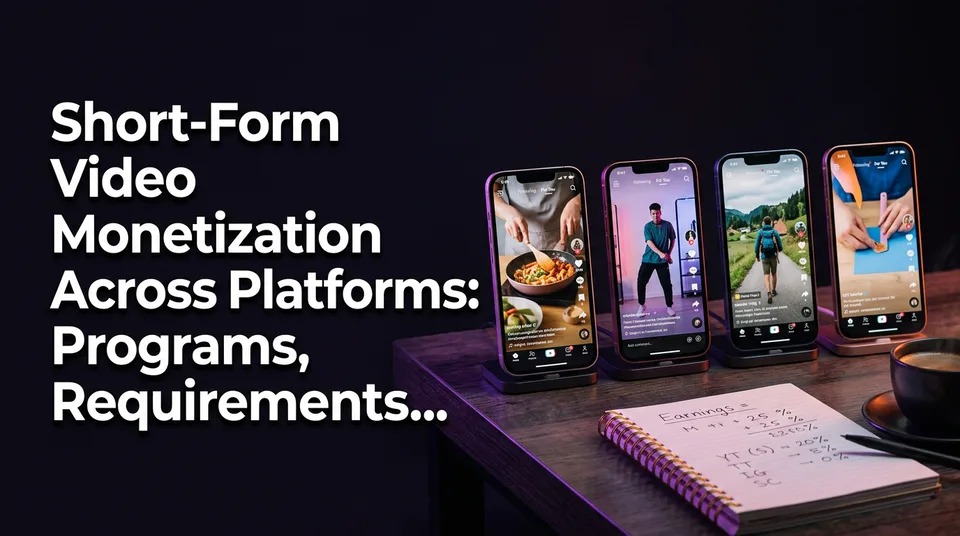
Short form video monetization is possible on YouTube Shorts, Facebook Reels, TikTok and Instagram Reels, but each platform runs a different program, asks for a different kind of eligibility (views, followers or subscribers, watch time, or an invitation) and pays by a different logic. None of them guarantees earnings. The comparison table in the requirements section below puts all four side by side.
So how much do monetized YouTube Shorts make? Usually far less per view than most people expect. Third-party estimates often put Shorts RPM (revenue per 1,000 views, after the platform's cut) at cents rather than dollars, and the real figure for your channel depends on your audience, your niche and the music in your videos. We'll do the math properly further down.
Key takeaways
- Yes, short videos get monetized, but only through specific programs you qualify for, and no platform promises a payout.
- Each platform measures something different: qualified Shorts views and subscribers on YouTube, eligibility and onboarding on Facebook, followers plus recent views on TikTok, and fan funding and brand deals on Instagram.
- YouTube Shorts pays from a shared revenue pool, not a flat per-view rate. Facebook, TikTok and Instagram use program-specific payouts, bonuses, gifts and subscriptions.
- Originality rules decide whether a page stays eligible. Reposted, mass-produced or watermarked clips are the fastest way to lose monetization.
- Use the formula earnings = views ÷ 1,000 × RPM with your own analytics. At illustrative Shorts RPMs, $2,000 a month takes millions of views.
- Brand deals, affiliate links and commerce don't need a platform threshold, so they're the practical route while you're still below the line.
How short-form video monetization works: four ways platforms pay
Short-form video monetization is the set of ways a platform, a fan or a brand turns your 9:16 videos into money, and there are four main mechanisms: a shared ad revenue pool, performance bonuses, fan funding, and deals or commerce around the video. Most pages end up combining two or three of them.
Here's how those four break down:
| Mechanism | Who pays | How it's calculated | Typical example |
|---|---|---|---|
| Ad revenue pool | The platform, from ad income | Share of a pool allocated by views, minus music licensing | YouTube Shorts |
| Performance bonus or program payout | The platform | Program-specific formula, often tied to qualified views or invited status | Facebook Content Monetization, TikTok Creator Rewards Program |
| Fan funding | Your audience | Gifts, subscriptions, tips, split with the platform | TikTok LIVE gifts, Instagram gifts and subscriptions |
| Deals and commerce | Brands or buyers | Negotiated fee, commission or sale price | Brand partnerships, TikTok Shop, affiliate links |
Platform payouts vs. income you control yourself
The first two rows in that table are platform payouts, and the platform controls them completely. It sets the threshold, the formula, the countries and the rules, and it can change any of them. Programs get renamed, paused or reshaped, so treat every rule here as something to confirm on the official page before you plan around it.
The last two rows are different. A brand deal or an affiliate commission doesn't care whether you've hit 10 million views. It cares whether your audience trusts you and buys. We've seen small pages with a tight niche and modest views earn more from one sponsor than from months of platform payouts. Not typical, but it shows where the control sits.
Why the same view can pay differently on each platform
One view can pay very differently on each platform because a view isn't the unit being paid. On YouTube, revenue is pooled and shared out, so your view is a slice of a bigger calculation. On TikTok, the qualifying unit is typically a view that meets the program's conditions. On Facebook, the payout logic is program-specific and depends on your onboarding.
And audience geography matters on all of them. Advertisers pay more to reach viewers in some countries than others, so 100,000 views from one region can be worth many times 100,000 views from another. That's why comparing "$ per 1,000 views" screenshots from strangers tells you almost nothing about your own account.
Monetization programs by platform and where each is documented
Each of the four platforms has one main program for short-form video, and each documents it in its own help center or creator hub that you should read directly. We'll name each program, say what it pays for, and point to the primary source. Platform rules change, so check the date on whatever page you read.
YouTube Shorts: YouTube Partner Program and the Shorts ad pool
YouTube Shorts earns ad revenue through the YouTube Partner Program, which pools Shorts ad income, subtracts music licensing costs, and pays creators a share set by YouTube. The program is documented in the official YouTube Partner Program overview and eligibility page, and the Shorts-specific rules are in YouTube's Shorts monetization policies.
There are two tiers. A lower tier unlocks fan-funding features, and the full ad-revenue tier unlocks the Shorts ad revenue pool and ad sharing on long-form videos. YouTube also pays YouTube Premium revenue when Premium members watch your content.
Facebook Reels: Content Monetization
Facebook Reels earns through Facebook Content Monetization, Meta's program that replaced several earlier, separate bonus programs. Access depends on your page or profile meeting eligibility and, in many cases, being onboarded in a supported country. Meta documents it through the Facebook creators hub and in-product on Meta Business Suite and professional mode settings; start at Meta's creator site.
The practical point: Facebook is the platform where being eligible is as much about account standing and originality history as raw numbers. A page with a record of reposting other people's clips can find the invitation never arrives, however good the views look.
TikTok: Creator Rewards Program, LIVE gifts and TikTok Shop
TikTok has three separate routes: the TikTok Creator Rewards Program, TikTok LIVE gifts and TikTok Shop. Creator Rewards pays for qualified views on eligible videos, and it has historically favored longer videos over very short ones. LIVE gifts are fan funding, and TikTok Shop pays commission on products you sell or promote.
The official source is TikTok's own creator guidance, starting from the TikTok Creator Academy. Region matters a lot here. A program available in one country may not exist in yours, and the details differ by market.
Instagram Reels: gifts, subscriptions and brand partnerships
Instagram Reels earns mainly through Instagram gifts and subscriptions (fan funding) and brand partnerships (paid collaborations), with occasional invite-only bonus programs that have appeared and disappeared over the years. Instagram's official creators site lists the monetization tools currently on offer and their conditions.
Our honest read: Instagram Reels is a strong place for brand deals and a weaker place for passive per-view income. If your goal is a steady platform payout, it's rarely the first platform to build around.
Monetization requirements by platform: what each one measures
The four platforms measure four different things: YouTube counts subscribers plus qualified views or watch hours, TikTok counts followers plus recent views, Facebook relies on eligibility and onboarding, and Instagram's tools depend on account type and region. That's why "how many views do I need?" has no single answer.
Every threshold below comes from public documentation or widely reported figures at the time of writing. Verify in the official help page before acting, because numbers move.
YouTube Shorts: subscribers plus 10M Shorts views in 90 days, or 4,000 watch hours
The full YouTube Partner Program tier requires 1,000 subscribers plus either 10 million qualified public Shorts views in the last 90 days or 4,000 public watch hours in the last 12 months. That's the tier that opens the Shorts ad revenue pool.
An earlier tier exists with lower numbers for fan-funding features: about 500 subscribers, three public uploads in the last 90 days, and either 3,000 watch hours in 12 months or 3 million Shorts views in 90 days. Both tiers also need the channel to follow YouTube's policies and have 2-step verification on. Check the YPP overview for the current wording.
Do Shorts views and watch time count toward monetization?
Qualified public Shorts views count toward the Shorts view route, and public watch hours from long-form videos, live streams and Shorts count toward the watch-hour route, as YouTube defines them. The two routes are alternatives, not a combined total, so 5 million Shorts views plus 2,000 watch hours doesn't add up to anything.
Two details trip people up. Only public views count, and YouTube's definition of a qualified view can exclude things like views it considers invalid. Read the exact definitions on the YPP overview rather than trusting a summary, including this one.
Country, age and account-standing conditions
Every program here is limited to supported countries, requires the account holder to meet age rules, and expects the account to be in good standing with no unresolved violations. These conditions are boring and they're the ones that block people.
Before you spend six months chasing a threshold, do three checks:
- Open the program page and confirm your country is on the supported list.
- Confirm the age requirement for the account holder, including any rules for adults managing a minor's channel.
- Check your account for strikes, restrictions or warnings that would block eligibility.
Comparison table: program, threshold type, payout logic, documentation
| Platform | Program | Threshold type | Payout logic | Documentation |
|---|---|---|---|---|
| YouTube Shorts | YouTube Partner Program, Shorts ad pool | Subscribers plus qualified Shorts views in 90 days, or watch hours in 12 months | Shared ad pool after music licensing; creator share set by YouTube | YouTube Help: YPP overview and Shorts monetization policies |
| Facebook Reels | Facebook Content Monetization | Eligibility and onboarding in supported countries, often by invitation | Program-specific payouts; no flat per-view rate | Meta creators hub and Meta Business Suite |
| TikTok | Creator Rewards Program, LIVE gifts, TikTok Shop | Followers plus recent views, age and region limits | Per qualified view, gifts split with TikTok, shop commission | TikTok Creator Academy and program pages |
| Instagram Reels | Gifts, subscriptions, brand partnerships | Account type, region and sometimes invitation | Fan funding split with Instagram; negotiated brand fees | Instagram creators site |
Originality and reused-content rules that decide eligibility
Originality rules apply on every platform, and a page can meet every numeric threshold and still lose or never gain monetization if its content is judged reused, unoriginal or mass-produced. We've watched pages lose reach for weeks after posting a handful of unoriginal clips, long before any formal strike showed up.
The platforms word it differently. YouTube talks about reused content and repetitious content, Meta talks about original content and unoriginal reposts, and TikTok talks about unoriginal content in its program rules. The principle is the same: the platform wants the thing you add, not the thing you copied.
What "reused", "unoriginal" and "repetitious" content means in practice
Reused content is material you took from someone else with little or no change, and repetitious content is the same template churned out so many times that each video adds nothing. Both get treated as low value.
In practice, these tend to get flagged:
- Re-uploads of another creator's video, even with a new title or a crop
- Clips with a visible watermark from another app or channel
- Slideshows or compilations that only string other people's footage together
- Dozens of near-identical videos that differ by one word on screen
None of this is a loophole hunt. If you're editing a clip so a platform's detection won't notice it, you've already misunderstood the rule. Content ID matching on YouTube is a copyright system separate from monetization policy, and neither is something to engineer around.
Compilations, clips and AI voiceover: what adds enough original value
Compilations, clips and AI-voiced story videos can be monetizable when you have the rights to the footage and add real original value: your own commentary, narration, structure, selection and editing. The footage has to be yours, licensed, or used with the owner's permission. Adding a voice doesn't launder someone else's video.
For story-style formats, the original part is the script and the voice. A narrated story you wrote or substantially shaped, told over footage you own or have permission to use, is a different thing from a muted repost with music on top. AI voiceover (text-to-speech) is allowed in principle on the major platforms, but each one expects it to carry real content, not to act as filler. We've kept this practical in the cross-platform routine below.
Strikes, demonetization and what a failed review looks like
A failed review usually looks like a "limited" or "not eligible" notice, a monetization status that flips off, or in the worse cases a copyright strike or removed video. YouTube reviews channels for reused content at the channel level, so one good video won't rescue a channel whose catalogue is mostly reposts.
If it happens, read the notice, fix the underlying pattern, and use the appeal or re-review path the platform offers. Deleting videos in a panic rarely helps and can destroy the evidence you need to show what you changed.
How much do monetized YouTube Shorts make?
Monetized YouTube Shorts typically earn cents per 1,000 views in third-party estimates, so a Short with 30,000 views might pay a few dollars at most. No one can give you your number, because it depends on your audience, niche, music and the pool itself.
How the Shorts revenue pool turns views into dollars
YouTube collects ad revenue from ads shown between Shorts, subtracts music licensing costs, and divides what remains among eligible creators based on their share of total Shorts views. The creator share is set by YouTube, and has been publicly described as 45% of the allocated amount; confirm the current figure on the Shorts monetization policies page.
That means you don't earn a fixed amount per view. A viral Short that mostly reaches low-value markets can pay less than a modest one that reaches high-value markets. Music-heavy Shorts also have more of their pool share offset by licensing.
Illustrative RPM ranges and why they vary widely
RPM is revenue per 1,000 views, after the platform's cut. CPM is what advertisers pay per 1,000 ad impressions, before the cut. Shorts RPM is often much lower than long-form RPM because Shorts ads are shared through a pool rather than sold against a single video.
For the math in this article, we use three assumed values: $0.03, $0.10 and $0.30 per 1,000 views. These are illustrative, not forecasts, and not a statement of what any platform pays. Real RPM varies by niche, audience country, season, music licensing and content type. Read the real number in YouTube Studio analytics for your own channel.
What 30,000 views might earn: a worked example
Take the formula earnings = views ÷ 1,000 × RPM and apply it to 30,000 views. At the assumed $0.03 RPM, that's 30 × $0.03 = $0.90. At $0.10 it's $3.00. At $0.30 it's $9.00.
So a Short with 30k views might earn somewhere between about a dollar and nine dollars, under these assumptions. If that's disappointing, it should be. It's why we tell page owners to treat Shorts ad share as one small stream, not the whole plan. Facebook page owners can also try the free WowReveal Facebook earnings calculator as a rough estimate, with the same caveat: it's an estimate, not a promise.
Which platform pays the most for Shorts, Reels and TikTok?
No platform pays the most for every page, and any ranking that claims otherwise is ignoring niche, audience country, eligibility and content type. A page with a US audience in a finance-adjacent niche and a page with a global audience in animal rescue will see entirely different results on the same platform.
Rate-based comparisons also mislead because the programs measure different things. Comparing YouTube's pool RPM to a TikTok Creator Rewards payout or a Facebook program payout is like comparing a salary to a tip jar. They're real, but they're not the same unit.
Variables that move earnings: niche, audience country, watch time, content type
Four variables move earnings more than which platform you pick:
- Niche: advertisers pay more to reach some audiences. Entertainment and animal clips usually sit lower than money, tech or business topics.
- Audience country: the same view is worth more in markets with higher ad spend.
- Watch time and completion: videos that people watch to the end get pushed further, which means more views to monetize in the first place.
- Content type: on TikTok, longer qualifying videos have been favored by Creator Rewards; on YouTube, a Short's music can reduce its pool share.
Choosing a primary platform by goal and eligibility, not by headline rates
Pick your primary platform by what you can actually qualify for and what you want to earn from. If you're already past 1,000 subscribers on YouTube, Shorts ad share is real. If your page is on Facebook and you have access to Content Monetization, Reels is where the payout lives. If you want brand deals and fan funding, Instagram and TikTok LIVE come first.
Then post the same core idea on the others, adapted properly, as secondary distribution. That's the routine we lay out in the last section. If you want a head-to-head on this decision, the related reading below goes deeper.
How many views do you need to earn $2,000 or $10,000 a month?
To earn $2,000 a month from YouTube Shorts ad share alone, you'd need roughly 6.7 million to 66.7 million views a month at the illustrative RPMs we're using, and for $10,000 it's roughly 33 million to 333 million. These are arithmetic, not predictions.
The views-to-dollars formula with low, mid and high RPM scenarios
Rearrange the earlier formula: views = target ÷ RPM × 1,000. Here are the results at our assumed RPMs:
| Assumed RPM (per 1,000 views) | Views for $2,000 | Views for $10,000 |
|---|---|---|
| $0.03 (low) | about 66.7 million | about 333.3 million |
| $0.10 (mid) | 20 million | 100 million |
| $0.30 (high) | about 6.7 million | about 33.3 million |
All three RPMs are assumptions chosen to show the range. If your analytics show a different RPM, plug that in. The point of the table isn't the specific number. It's that the answer is in the millions, every month, and that a 10x difference in RPM changes the answer 10x.
Why most accounts earn far less than the headline examples
Most accounts earn far less than the headline examples because headline examples are survivors. You see the account that hit 3.4 million views in a few weeks, not the thousands that posted for months and stayed under 1,000 views per video.
Reddit threads on this topic are consistent: creators with millions of Shorts views and 1,500 new subscribers report income that barely covers a coffee, and some can't earn at all until they cross the YPP line. That matches the math above. Views are cheap to generate and cheap to monetize, and the real value is in what you build off them: subscribers, a niche, an audience a brand might want.
Beyond platform payouts: brand deals, affiliate, commerce and licensing
You can earn from short videos without hitting any platform threshold by selling through them: brand partnerships, affiliate links, your own products, or licensing your footage. These routes pay for attention and trust, not for crossing a numeric line.
Here's how each works at small scale:
- Brand partnerships: a business pays for a mention or a dedicated video. Small, tightly niched pages can be more attractive than big generic ones. Disclose paid content as each platform requires.
- Affiliate links: you earn a commission when viewers buy through your link. It works best when the video genuinely shows or uses the product.
- Commerce: TikTok Shop and similar features let you sell directly. Availability depends on region and account standing.
- Licensing: if you own original footage, other creators or publishers may license it. Only footage you own or hold the rights to belongs here.
We'd rather you build one of these before you have 100,000 followers than wait for a program to open. A page with 3,000 engaged followers in a defined niche can be worth more to the right brand than a page with 300,000 random ones.
A cross-platform publishing routine that keeps your videos monetization-safe
A monetization-safe routine means every video is original in substance, formatted correctly for 9:16, and adapted per platform rather than blindly reposted. Reposting identical files everywhere isn't the safe shortcut it looks like, and on some platforms duplicated or watermarked uploads get reduced distribution.
Pre-publish checklist for every Reel and Short
Run this before each upload:
- Confirm you own the footage, hold a license, or have written permission.
- Check there's no watermark from another app or channel in the frame.
- Confirm the video adds something: your narration, your script, your edit, your selection.
- Export at 9:16, 1080×1920, with readable captions in the safe area, away from the interface buttons.
- Check the music is licensed for the platform and the account type.
- Write a title and description specific to this video, not recycled.
- Open the first 2 seconds and ask whether a stranger would stay. The hook is where retention is won or lost.
The deeper version of this lives in the related checklist article below.
Making one video in several versions with AI tools without triggering reused-content flags
You can make one idea into several platform-specific versions by changing what's substantive: the opening hook, the length, the captions, the narration language and the cut, not just the file name. A 45-second version for Facebook Reels, a tighter 25-second version for TikTok, and a captioned silent-friendly cut for Instagram are different videos built from the same source idea.
This is where we've built WowReveal around the workflow. The AI Clipper finds the best moments in a long video you own or have rights to, so you aren't scrubbing a timeline by hand. The story and AI voiceover tools write and voice a narrated version in 9 languages, and animated captions, a headline, music and a cover come with the render. The post kit writes titles, descriptions and hashtags per platform.
A tool doesn't make content original. You do, by supplying the footage rights, the angle and the judgment. The tool just takes 20 minutes of work down to a couple of minutes.
Tracking results per platform: views, completion and revenue
Track three numbers per platform, weekly: views, completion rate (how many viewers watch to the end), and revenue from the program itself. Views tell you reach, completion tells you quality, and revenue tells you whether the platform is worth your time.
Keep a plain spreadsheet with one row per video and one column per platform. After a month, you'll see which format holds attention and which platform actually pays you. Move your effort toward that one, and don't trust any "best platform" claim over your own data. Eligibility and payout rules change, so recheck the official help pages every few months.
Frequently asked questions
Do short videos get monetized?
Yes, but only through specific programs you qualify for: the YouTube Partner Program, Facebook Content Monetization, TikTok's Creator Rewards Program, and fan funding or brand deals on Instagram and TikTok. Each has its own thresholds, and no platform guarantees earnings.
How much is paid for 1,000 views on YouTube Shorts?
There's no fixed rate. Shorts revenue comes from a shared pool, and third-party estimates often land at cents per 1,000 views, not dollars. Your real RPM is in YouTube Studio analytics and varies by audience country, niche and music.
How many YouTube Shorts views do I need to make $2,000 a month?
Use views = target ÷ RPM × 1,000. At illustrative RPMs of $0.03, $0.10 and $0.30, that's roughly 66.7 million, 20 million and 6.7 million views a month. These are assumptions for arithmetic, not forecasts.
How many views do you need on YouTube Shorts to make $10,000?
At the same illustrative RPMs, about 333 million, 100 million and 33 million views. Reaching numbers like that is rare, which is why most creators combine platform payouts with brand deals, affiliate income or commerce.
Do YouTube Shorts views and watch time count for monetization?
Qualified public Shorts views count toward the Shorts view route (10 million in 90 days for the full tier). Public watch hours from long-form, live and Shorts count toward the 4,000-hour route. The two are alternatives. Check the YouTube Partner Program overview for the exact definitions.
Which platform pays the most for short videos?
None pays the most for everyone. Earnings depend on your niche, audience country, watch time, eligibility and content type, and the programs pay in different ways. Choose a primary platform by what you can qualify for and what you want to earn from.
How can I monetize short videos without hitting platform thresholds?
Sell through the videos: brand partnerships, affiliate links, your own products, TikTok Shop where available, or licensing footage you own. These depend on audience trust rather than a view count, and disclose paid content as each platform requires.
Can reposted or compilation videos be monetized?
Reposting other people's videos without permission puts monetization at risk on every platform. Compilations and clips can be eligible only when you have the rights and add real original value, such as your own narration, structure and editing. Rules differ and change, so check each platform's policy.
Where to go next
- Facebook Reels vs YouTube Shorts vs TikTok: Where to Post to Earn — the head-to-head if you're deciding which platform to build on first.
- What Is YouTube Shorts Revenue Sharing? How the Ad Pool Pays Creators — the pool mechanics behind the Shorts earnings math.
- What Is RPM for Creators, and How Is It Different From CPM? — read this to interpret the RPM figures correctly.
- Facebook Reels Monetization: How It Works, Who Can Earn and What to Expect — detail on Facebook Content Monetization eligibility and payouts.
- Instagram Reels Monetization: Bonuses, Gifts, Subscriptions and Brand Deals — what Instagram's tools actually offer.
- Reused Content Policies Compared: Facebook, YouTube and TikTok — the originality rules in full detail.
- Are AI Story Videos Allowed on Facebook and YouTube? — how AI voiceover and story formats fit the rules.
- Monetization-Safe Shorts: A Pre-Publish Checklist for Every Reel and Short — the checklist to run before every upload.
- Best Niches for Facebook Reels: How to Choose One That Fits Your Page — pick a niche that suits your audience and eligibility.
- Facebook Niche List: Categories Pages Commonly Use for Reels — a wider list of categories to consider.
- Niche Templates for Reels: Repeatable Formats for Daily Posting — formats you can repeat without becoming repetitious.
- Best Reel Length and Pacing for Completion Rate — how length and pacing affect watch time and retention.
- How to Find Trending Reels and Spot Formats Before They Peak — find topics worth making before they saturate.
- AI Short Video Creation for Reels and Shorts: The Complete Guide — the next step if you want to produce videos faster.
- AI Story Video Generator: How to Turn a Story into a Short
- Facebook Content Monetization Requirements Explained: Who Qualifies and How Approval Works
- YouTube Shorts Monetization Requirements: Who Is Eligible and How to Check
- TikTok Monetization Requirements for Short-Video Creators: What You Need and How to Check
Turn any video into a ready-to-post Reel
Paste a link — WowReveal writes the story, voices it in 9 languages and adds captions, a headline and music. Start with free credits, no card.
Start free →