Motivational and Facts Shorts: Format, Pacing and Script Structure
A motivational or facts Short is a script problem. Here's the hook, the word budget, the fact-check routine and the angle that stops your page looking generic.
In this article
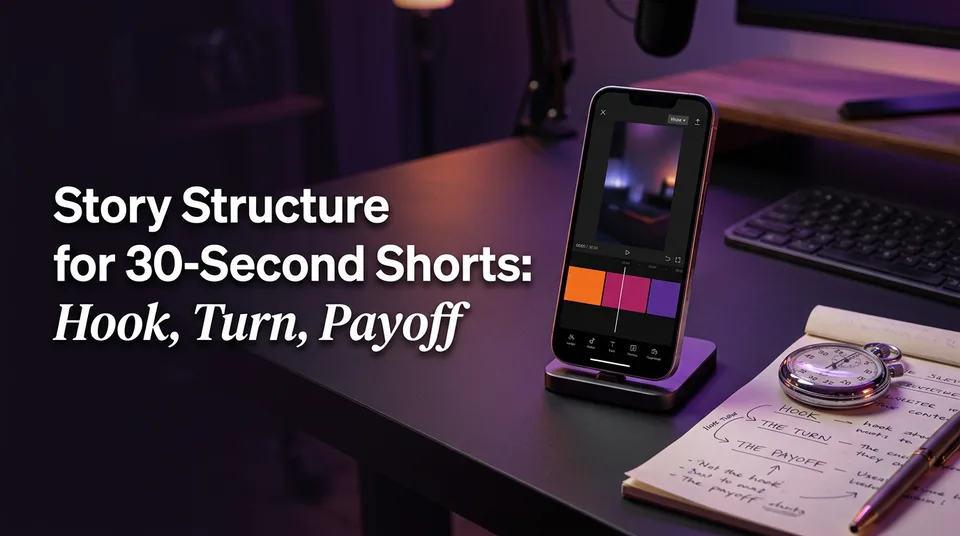
A motivational facts shorts format has three parts: a hook in the first 1-2 seconds, 4-6 short facts or beats read at a steady voiceover pace, and an ending that loops back to the hook, all in roughly 25-40 seconds. That's the whole skeleton. Everything else is script quality, and script quality is where most faceless format pages fall apart.
The format at a glance: hook, fact sequence, loop ending
To make a motivational or facts Short, write the script first in three blocks (hook, beats, loop ending), then add voice and visuals. Reverse that order and you end up editing around weak words.
The hook (first 1-2 seconds)
The hook is one sentence of 5-8 words that opens a question the viewer wants closed. "Your brain lies to you every morning" works. "Hey guys, today we're talking about" doesn't. No intro, no logo sting, no greeting. Swiping is instant on YouTube Shorts, TikTok, Facebook Reels and Instagram Reels, so the first sentence has to be the strongest one you have.
The fact or beat sequence
Use 4-6 beats, each carrying one idea. Five is the sweet spot for a 35-second video. A good beat survives alone: if you pasted it as a caption on a blank screen, it would still make sense.
The loop ending
The last line should flow back into the first line when the video restarts. If the hook is "Your brain lies to you every morning," the closer might be "...and that's why it lies to you every morning." A clean loop invites rewatches, which can help your completion rate, the share of viewers who reach the end.
Writing the script: length, word count and structure
A facts Short should run 25-40 seconds, which means roughly 80-110 words at 2.5-3 spoken words per second. This also answers the common question of how long a facts short should be: shorter than you think, and never padded to hit a number.
| Block | Time | Words |
|---|---|---|
| Hook | 1-2 seconds | 5-8 |
| 4-6 beats | 5-7 seconds each | 14-18 each |
| Loop ending | 3-4 seconds | 8-12 |
| Total | 30-40 seconds | 80-110 |
Write for the ear, not the page. Short sentences, plain words, one idea each. Read the draft aloud with a stopwatch, and cut every word that doesn't change the meaning.
The motivational reels format uses the same skeleton, but beats become turns instead of facts: name the struggle, flip it, give one action you can do today. The WowReveal script writer drafts this structure from a topic, but treat its output as a first draft you edit, not a finished script.
Pacing the voiceover and visuals
Pace the voiceover at 2.5-3 words per second, one idea per sentence, with a short pause between beats. Fast enough to hold attention, slow enough that a line can land.
Words per second and pause length
Above 3 words per second, motivational content sounds rushed and loses its weight. Leave about 0.3-0.5 seconds of silence between beats. That gap is what makes the next line feel like a new idea.
The best AI voice for motivational videos is a calm, clear one that fits the tone. Skip anything chirpy for serious material. Render the same script in 2-3 voices and listen on a phone speaker, since that's where viewers will hear it. The WowReveal voiceover tool covers 9 languages, so you can test AI voiceover options in your audience's language before committing.
Matching a visual change to each beat
Change the visual every 2-3 seconds, which is roughly 12-17 changes in a 35-second Short. Tie the major changes to beats so picture and sentence move together. Use licensed or generated footage and licensed music, never clips you don't have rights to.
Captions that follow the voice
Animated captions synced to speech, 2-4 words at a time, keep eyes on the screen and cover the many people watching muted. Keep them large and out of the bottom edge where platform buttons and descriptions sit.
How to verify facts before you post
Check every claim against two independent, reliable sources, and note the date you checked. One source isn't a check, it's a rumor with a link. Two sources that both copy a third don't count either.
Three habits make this routine:
- Drop absolutes. "Always," "never," "100% of people" are the claims that break first.
- Cut anything you can't trace to a named source. "Scientists say" is not a source.
- Fix errors fast. If a viewer catches one, correct it or replace the video and say so in the comments.
We've watched pages lose credibility overnight when a viral fact turned out wrong and the comments filled with corrections. Accuracy also supports monetization. The YouTube Partner Program overview is the starting point for how YouTube treats original, advertiser-friendly content, and platform rules change, so recheck the current policies before you rely on them.
Avoiding a generic feel in a crowded niche
Pass a one-sentence test: "This page is the only one that for ." If you can't finish it, you're the thousandth quote-and-stock-footage channel. Three angles help you finish it.
- Narrow sub-topic. Not "facts" but facts about sleep for night-shift workers, or motivation for first-time managers.
- Recurring framing device. A series name or fixed opener, like "The 30-second reframe," gives viewers a reason to follow.
- Clear point of view. Take a position. "Motivation is a bad plan, here's what works" beats a recycled quote every time.
The best motivational short videos we see share this: one idea, a point of view, a clean ending. Production polish comes second.
Monetization risk lives here too. Write your own script, use your own voice or AI voice, and use licensed or generated visuals and music. Repackaged quote compilations and copied clips are what originality checks on Facebook content monetization and the YouTube Partner Program are built to catch.
Making one with AI: a quick workflow
You can go from topic to a rendered 9:16 video in five steps, and an AI motivational video generator handles production, not your judgment. The workflow:
- Pick your sub-topic and write the one-sentence test.
- Draft the script (hook, 4-6 beats, loop ending), then verify every fact yourself with two sources.
- Generate the AI voiceover in a calm voice and check the pacing against the 80-110 word budget.
- Add visuals, animated captions, music and a cover, then render at 1080×1920.
- Post the same file on each platform with its own title and description.
WowReveal handles steps 3 and 4 in one place: story voiceover, captions, headline, music, cover and 9:16 render. For how to make motivational videos on TikTok, the process is identical. Keep key text away from the bottom and right edges, where the interface covers it.
Frequently asked questions
How long should a facts short be?
Aim for 25-40 seconds, or about 80-110 words at 2.5-3 spoken words per second. Stop when the last beat lands. Padding to hit a length hurts completion rate.
How many facts should one Short have?
Four to six. Fewer feels thin, more forces you to speak faster than 3 words per second, and viewers stop absorbing anything.
Can I use AI to write the whole script?
You can use AI for a first draft, but verify every fact against two independent sources and add your own point of view. Unchecked AI output is a common source of wrong claims.
Where to go next
- Story Voiceover Shorts: Structure, Voice and Pacing — Goes deeper on narration structure and voice choice for narrated formats.
- Best Reel Length and Pacing for Completion Rate — Backs the length and pacing numbers with completion-rate context.
- What Is Completion Rate on Reels and Shorts? — Explains why the loop ending and short length matter.
- Faceless Shorts with AI: How to Make Them Step by Step — Gives the full production workflow once your script is ready.
- Competitor Page Research for Reels Niches: A Repeatable 5-Step Review — Helps you find a differentiated angle in a saturated niche.
Generate your reel right now
Paste a link to any video — WowReveal writes the story, voices it and adds captions, a headline and music. Ready for Reels, Shorts and TikTok.
No link? Upload a file
- 30 free credits
- No card needed
- Voiceover in 9 languages
- Failed jobs refunded