Animal Rescue Reels: Format, Pacing and Rules
A beat-by-beat guide to animal rescue Reels: the three-beat format, pacing for 20–40 seconds, and the rights and authenticity rules that keep a page safe.
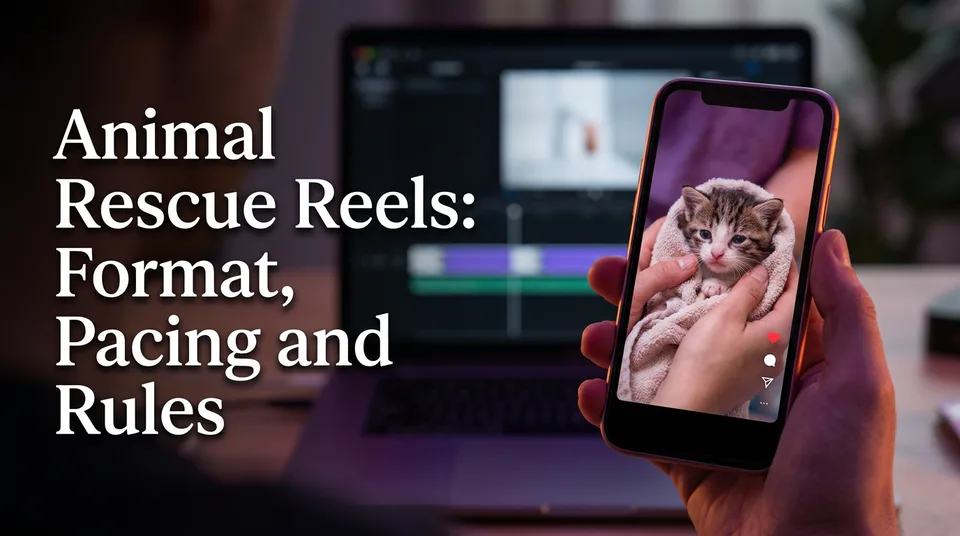
A good animal rescue Reel follows a problem → rescue → payoff structure, opens on an emotional hook within the first 3 seconds, and uses only footage you own or have licensed, with original narration and no staged rescues. Get those four things right and animal rescue reels are one of the more dependable formats on Facebook Reels. Skip any one and you risk reach, trust, or both.
The animal rescue Reel format: problem, rescue, payoff
The format that works is three beats in a fixed order: the animal is in trouble, someone helps, and we see the animal changed. Viewers don't need to be told it's a story. They feel the arc, and they stay to see the ending.
Beat 1: the problem and the hook
Open on the animal in trouble, not on a title card or a logo. A puppy wedged under a fence, a kitten shivering in a drain, a dog with matted fur at the roadside. Frame tight on the animal's face or the obstacle.
The hook is the most visible moment of need, shown in the first 3 seconds. Add one line of text or narration that raises the question: "Nobody stopped for this dog for 3 days."
Beat 2: the rescue
The rescue is the action: the hands, the net, the blanket, the slow approach. Show process, not just result. Cut between wide shots and close-ups so the viewer sees both the danger and the care.
Keep it honest. If the rescue took patience and 40 minutes, say so in your narration and show the best 10 seconds of it.
Beat 3: the payoff
The payoff is the reveal: clean, fed, warm, maybe adopted. Hold it a little longer than feels natural, 4 to 6 seconds, because that's the moment viewers came for.
End on the animal looking at the camera, or at the person who helped. Skip the long outro.
Pacing a rescue Reel beat by beat
Most animal rescue reels perform best between 20 and 40 seconds in 9:16 vertical video, with a new visual every 2 to 4 seconds and the payoff near the end. Treat these as starting points to test on your own page, not guarantees. Retention curves differ by audience.
A timing template for 20–40 seconds
Here's the sheet we'd start from for a 30-second Reel. Scale it up or down.
| Beat | Seconds | What's on screen | Job |
|---|---|---|---|
| 1. Problem + hook | 0–6 | Animal in trouble, tight framing, one text line | Stop the scroll in the first 3 seconds |
| 2. Rescue | 6–22 | 4–6 cuts, wide then close, steady narration | Build tension and show the care |
| 3. Payoff | 22–30 | Clean, fed, calm animal; held final shot | Reward the viewer, invite a share |
If your completion rate sags, look at beat 2 first. Rescue sequences run long because the footage feels precious. Cut harder than you want to.
Rights: use footage you own or license
You may only post rescue footage you shot yourself, own, or have written permission or a license to use. Re-uploading someone else's clip, even with credit, is the fastest route to takedowns and weak originality signals.
A short rights checklist before you publish:
- You filmed it, or the owner gave you permission in writing (a message counts, a "sure, go ahead" in a comment doesn't).
- The permission covers monetized use, not just sharing.
- You've kept a screenshot or file of that permission.
- Any music is licensed for commercial use.
- No watermark from another creator or page is visible.
Platform rules change, so check the current wording in the Meta Business Help Center before you build a page around any policy. And skip any advice about cropping or filtering a clip to dodge Content ID or originality checks. It's the wrong fix, and it doesn't make the footage yours.
Avoid fake and staged rescues
Staged rescues, where an animal is placed in danger so someone can "save" it, are a documented trend and a real risk to your page. World Animal Protection has published research on fake animal rescue content spreading across Facebook, Instagram, YouTube and TikTok; read it at worldanimalprotection.org.
Beyond the ethics, which should settle it, the practical case is simple. Viewers have learned to spot staged clips, comment sections turn on pages that post them, and platforms can limit distribution or monetization on content that harms animals. We've watched pages lose months of momentum from one clip that looked set up.
So don't place animals in danger. Don't film a "rescue" you didn't do. If you didn't see the beginning, don't imply you did. Real footage plus honest narration is more watchable anyway.
Add a story voiceover for originality
An original story voiceover turns a clip into your own piece of work, and it helps viewers trust what they're seeing. Your commentary, the context and the details you choose are what make a Reel more than a re-upload. That's the core of originality for Facebook content monetization.
Write the narration in three short parts: the situation, what was done, how it ended. Keep it to about 60–90 words for a 30-second Reel. Mention real details, like where the animal was found and what the vet said, never invented ones.
If recording your own voice isn't practical, AI voiceover (text-to-speech) can narrate your script, and WowReveal's voices cover 9 languages, which helps non-native English speakers publish clean narration. The WowReveal animal rescue template pairs the story, voiceover, animated captions, a headline and a cover in one 9:16 render. If you're working from a longer video you own, the AI Clipper finds the strongest moments so you aren't scrubbing a timeline by hand.
Packaging matters here. Captions, a headline and a cover should tell the story at a glance, even with the sound off.
Animal rescue video ideas that fit the format
The ideas that fit best are ones where the problem is visible, the helper is present, and the change is obvious. Some starting points:
- A stray found in bad weather, followed by the first meal and the first warm bed.
- A before-and-after of a neglected pet after grooming and vet care.
- A foster update: week 1, week 4, adoption day.
- A trapped animal freed by a volunteer or local responder.
- Wholesome kindness shorts: a stranger stopping traffic for a duck family.
Wild animal rescue videos need extra care. Don't touch or handle wildlife for the camera. Use footage you shot from a safe distance, or work with licensed rehabilitators who agree to be filmed and give you permission in writing.
Why do rescue kitten videos go viral? Our read, not a measured fact: kittens are small and obviously helpless, the stakes are clear in one frame, the resolution is fast, and nobody needs a translation. Those same traits are what the three-beat format borrows.
If you're wondering about animal rescue reels free of cost, shoot on your phone and use footage that's already yours. WowReveal also starts you with free credits and no card. Don't hunt for "free" clips from other pages, because free to watch isn't free to reuse.
Is animal rescue the best niche for Facebook Reels?
Animal rescue is a strong niche for Facebook Reels, but the best niche is the one you can feed with original, rights-clean footage every week. A niche you can't source honestly will stall no matter how popular it looks.
Rescue works when you have real access: your own animals, a shelter partner, a fostering routine. It's weaker if your plan is to collect clips from elsewhere. In that case, pick a niche where your own commentary carries the video.
Nothing here promises views or income. Meta decides Facebook content monetization eligibility, and YouTube Shorts, TikTok and Instagram Reels each have their own rules. The same 9:16 Reel can go on all four, but check each platform's policies before posting.
Frequently asked questions
Are animal rescue videos real?
Many are, but fake and staged rescues are a documented trend across Facebook, Instagram, YouTube and TikTok. Film only rescues you actually carried out or witnessed, and narrate honestly about what happened.
Can I repost a viral rescue clip if I credit the owner?
Not safely. Credit isn't permission. Get written permission or a license that covers monetized use, keep proof, and add your own narration so the Reel is original work.
How long should an animal rescue Reel be?
Start with 20–40 seconds, a new visual every 2–4 seconds, and the payoff near the end. Treat that as a starting point and adjust to your own retention data.
Where to go next
- Hooks for Reels and Shorts: How to Win the First 3 Seconds — helps you write the emotional hook for beat 1.
- Best Reel Length and Pacing for Completion Rate — goes deeper on the pacing beats used in the timing template.
- Original Content on Facebook Reels: What Counts and What Doesn't — explains why narration and rights matter for originality.
- How to Add AI Voiceover to Reels, Step by Step — practical steps for adding the story narration.
- Monetization-Safe Shorts: A Pre-Publish Checklist for Every Reel and Short — gives you a final check before you post a rescue Reel.
Turn any video into a ready-to-post Reel
Paste a link — WowReveal writes the story, voices it in 9 languages and adds captions, a headline and music. Start with free credits, no card.
Start free →