What Is a Good Retention Rate for Shorts? Benchmarks and How to Read Them
There's no official good retention rate for Shorts. Here's how to read your average percentage viewed, judge 80% or 44%, and build a benchmark from your own videos.
In this article
There's no single official good retention rate for Shorts. It depends on video length and niche, shorter Shorts naturally score higher, and 70–80%+ is often cited as strong for short clips, but the most reliable benchmark is your own recent Shorts. An 80% rate is generally good, especially on a longer Short, though length and looping change what the number means.
That's the short answer. The useful part is knowing how to read the number you're staring at in YouTube Studio.
How Shorts retention is calculated
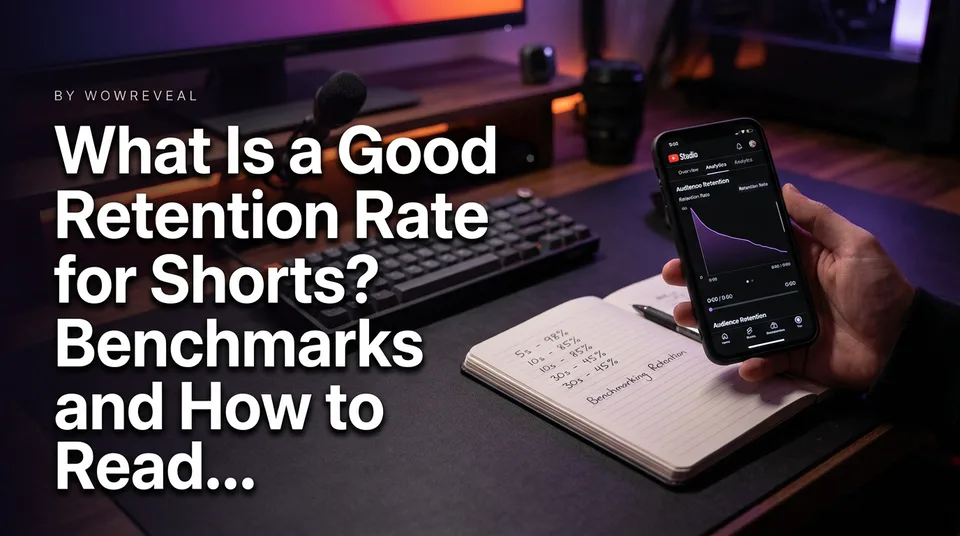
Average percentage viewed (APV) is average view duration divided by video length, multiplied by 100. It tells you what share of a Short the typical viewer watched, and it's the number most people mean when they say "retention rate" for Shorts. YouTube explains its audience retention reports in the YouTube Help documentation, and the exact labels in Studio can change over time.
Average view duration vs average percentage viewed
Average view duration (AVD) is raw time: 9 seconds, 14 seconds, whatever. APV turns that time into a percentage of the video's length.
The difference matters. A 14-second AVD sounds great on a 15-second Short and mediocre on a 55-second one. APV makes both comparable, but only roughly, and we'll get to why.
Worked example: 18 seconds watched on a 25-second Short = 72%
Take a 25-second Short with an AVD of 18 seconds. Divide 18 by 25 and you get 0.72, so APV is 72%.
Now cut the same story to 15 seconds and keep the same viewers' behavior. They'd probably watch less in absolute terms, but the percentage could climb. That's the first hint that APV is partly a function of length.
What counts as a good retention rate for Shorts?
A good retention rate for Shorts is one that beats your own typical result at the same length. YouTube doesn't publish a pass mark, and no official threshold exists for monetization or reach.
Rough ranges people quote, and why they are not official
You'll see Reddit threads and tool blogs repeat figures like these:
- Around 60–70% is "solid"
- 70%+ is "excellent"
- 80%+ is "top-performing"
Treat all of that as unofficial rules of thumb, not YouTube data. They rarely say what length of Short they measured, which is the one thing that decides whether the number is impressive. A flat threshold with no method isn't a benchmark.
Is 80% retention good? What about 44%?
80% is generally strong, and 44% is neither good nor bad until you know the length. Both need a length bucket before you can judge them.
Why 80% on a 10-second Short is not the same as 80% on a 50-second one
80% of 10 seconds is 8 seconds watched. 80% of 50 seconds is 40 seconds. The second is far harder to earn, because you've held attention five times longer.
So 80% on a 50-second Short is excellent. On a 10-second Short it's decent, and sometimes just average for that format. And 44%? On a 45–60 second Short that can be perfectly normal. On a 12-second Short it points to a weak hook, since viewers left before the clip was half over.
When a score above 100% is just looping
Shorts replay automatically, so on very short clips viewers often watch the loop twice. AVD can then exceed the video's length, and APV can climb past 100%.
That isn't a bug, and it isn't automatically a win. A 7-second Short with 130% APV may simply be so short that it loops by default. Read it alongside viewed vs swiped away, the share of people who stayed instead of flicking past in the first seconds. High APV with a poor viewed rate usually means a small, loyal slice of viewers is replaying while most leave instantly.
Retention rate by video length
Shorter Shorts score higher APV than longer ones, almost by definition. Less to watch means a bigger share gets watched.
Shorts can now run up to 3 minutes, though platform rules change, so check YouTube's current help pages. Most daily-posting pages still live between 15 and 60 seconds. We've seen pages chase a "high retention" number by chopping a good story down to 8 seconds, then lose the viewers who actually wanted the payoff.
There's no magic length for going viral either. Pick the shortest length the story needs, and don't pad it to fill space. Completion rate, the share who reach the end, is a close cousin of APV and worth reading next to it.
How to benchmark against your own Shorts
Your best benchmark is the median APV of your last 15–20 Shorts in the same length band. Use the median, not the average, because one viral outlier or one flop can drag an average far off.
A 4-step self-benchmark
- Bucket by length. Sort your last 15–20 Shorts into bands, for example under 15 seconds, 15–30 seconds, and 30–60 seconds.
- Take the median. Line up each band's APV values from lowest to highest and take the middle one.
- Flag outliers. Mark anything more than about 10 points above or below the median. Open those videos and ask what was different: hook, topic, length, pacing.
- Check viewed vs swiped away. Compare it with the same Short's APV. A great APV with a weak viewed rate means the first seconds are losing people.
| Length band | Your median APV | New Short | Verdict |
|---|---|---|---|
| Under 15 s | (your number) | (new number) | Above, near or below |
| 15–30 s | (your number) | (new number) | Above, near or below |
| 30–60 s | (your number) | (new number) | Above, near or below |
Fill it in once a week. After a month you'll know more than any blog threshold can tell you.
What to do when your retention is below your baseline
When a Short lands below your median, open the audience retention graph and find the exact second where the line drops. The fix is almost always at that point, not in the whole video.
A steep drop in the first 3 seconds means a hook problem. A slow bleed means dead air or a flat middle. A cliff near the end means you promised something the ending didn't deliver.
Cut the slow stretch, tighten the opening line, and add captions so people can follow on mute. If you start from long footage, WowReveal's AI Clipper can pull the strongest moments and add animated captions, which saves you the manual trimming. Either way, test one change at a time.
One caution. Retention is a diagnostic, not a promise. A strong APV doesn't guarantee views, and it doesn't guarantee income, since YouTube decides distribution and monetization eligibility.
Frequently asked questions
Is 80% retention good on YouTube Shorts?
Generally yes, especially on Shorts longer than 30 seconds. On a 10-second Short it's closer to decent, since 80% is only 8 seconds, and replays can inflate it.
Is a 44% retention rate good?
It depends on length. On a 45–60 second Short it can be normal, while on a 12-second Short it usually signals a weak hook. Compare it with the median of your own Shorts in the same length band.
How many Shorts do I need for a reliable benchmark?
Use your last 15–20 Shorts of similar length and take the median. Fewer than about 10 per band makes the number too jumpy to trust.
Where to go next
- What Are Watch Time and Retention Rate on Short Videos? — Start here if you want the base metrics defined before benchmarking them.
- What Is Completion Rate on Reels and Shorts? — Shows how completion differs from average percentage viewed.
- How Long Should a Clip Be for Shorts and Reels? — Helps you choose the length bands you benchmark against.
- How to Find Where Viewers Drop Off in Your Shorts (and What to Fix) — The next step once a Short falls below your baseline.
- Short Video Retention: How to Get Reels and Shorts Watched to the End — The broader system for improving retention across every video.
Generate your reel right now
Paste a link to any video — WowReveal writes the story, voices it and adds captions, a headline and music. Ready for Reels, Shorts and TikTok.



No link? Upload a file
- 30 free credits
- No card needed
- Voiceover in 9 languages
- Failed jobs refunded