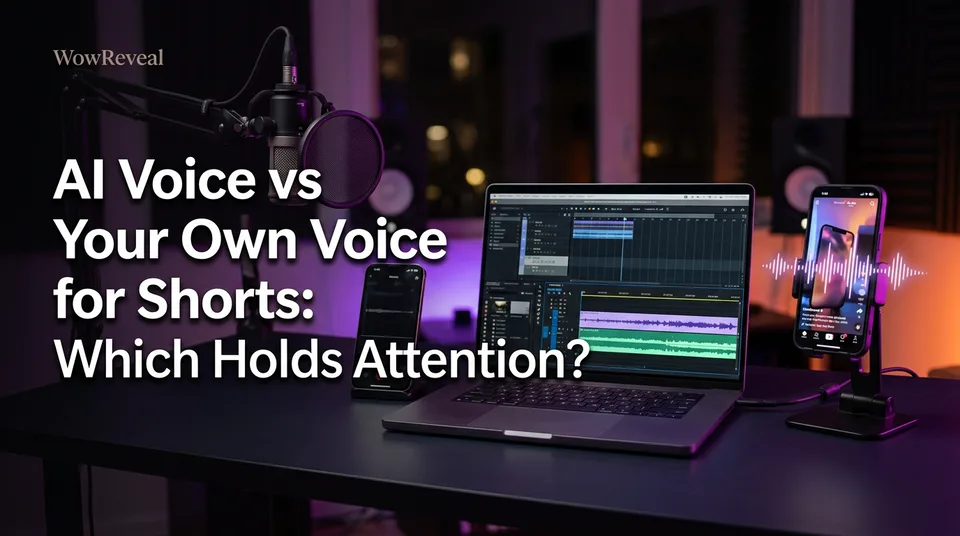
AI Voice vs Your Own Voice for Shorts: Which Holds Attention?
Is AI voice good enough for Shorts? Compare it with your own voice on retention, speed, cost and platform rules, then pick by niche or test both on your page.
In this article
For most faceless story, compilation and explainer Shorts, a good AI voice holds attention about as well as a recorded voice, because retention depends on script, hook and pacing more than on voice type. Your own voice wins when you are the personality, or when the content leans on emotion and trust. And platform rules judge originality, not whether the voice is AI.
That's the short answer to the ai voice vs human voice shorts question. The long answer depends on what you post. A page publishing three story Reels a day has a different problem from a face-on-camera personal-brand channel, where your voice is the product.
Key takeaways
- A clear, well-paced AI voice is good enough for narration-driven faceless Shorts. A flat read on a weak script is not.
- Hook, script and pacing move retention more than the voice source. Test it instead of assuming.
- Recording costs time on every single Short. AI narration costs a few credits and a few minutes, and the gap grows with daily posting.
- YouTube, Facebook and TikTok judge whether content is original and adds value. They don't ban AI voice as such.
- Use your own voice for personality, podcast and trust-heavy content. Use a hybrid (your hook, AI body) when you want both.
AI Voice vs Your Own Voice: Side-by-Side Comparison
The difference between a human voice and an AI voice comes down to five things: quality, speed, cost, rules exposure and control. Here they are in one place.
| AI voice (text-to-speech) | Your own voice | |
|---|---|---|
| Input | Written script | Script plus a microphone and a quiet room |
| Output | Finished audio in minutes, regenerable | Raw takes that need cleanup |
| Emotion and humor | Limited, improves with script and voice choice | Strongest option |
| Consistency | Same tone on every Short | Varies with energy, health, room noise |
| Languages | Many, no re-recording (9 in WowReveal) | Only the ones you speak well |
| Cost model | Credits or subscription per generation | Gear and your time |
| Rules exposure | Same originality rules as any content | Same originality rules as any content |
| Best for | Faceless story, compilation, explainer, multi-language pages | Personal brand, podcast clips, trust-led content |
Winner: depends on whether you are the point of the video. If you aren't, AI voice usually wins on speed. If you are, nothing replaces you.
Does AI Voice Hurt Retention?
AI voice does not hurt retention by itself; a weak hook, a padded script or a monotone read does. We've watched pages blame the voice for drops that were actually a slow first sentence.
Nobody can honestly promise a view or earnings effect in either direction. Results vary by niche, audience and script.
What viewers react to: pacing, hook and clarity, not the voice source
Viewers decide in the first 3 seconds whether to stay, and they decide on the hook, the image and the energy, not on who is speaking. After that, audience retention follows pacing: sentences that move, a new piece of information every few seconds, no dead air.
A strong script read by a decent AI voice beats a rambling script read by you. That's uncomfortable, but it matches what we see when comparing pages.
Where listeners notice a flat or robotic read
Listeners notice a flat read when every sentence ends on the same pitch, when pauses land in the wrong places, and when the voice stumbles on names, acronyms or numbers. Long stretches of narration with no variation are the worst offenders.
Default, cheap text-to-speech voices are the usual culprit. Newer AI voice generators handle intonation far better, but they still need a script written for the ear.
Winner: depends on the script. Fix the hook first, then argue about voices.
Can People Tell the Difference?
Sometimes, yes, and often it doesn't matter. Many listeners can spot a basic text-to-speech voice within a sentence or two. A modern voice from a tool like ElevenLabs or a platform's built-in AI voiceover is much harder to pick out, especially under music and with animated captions on screen.
Reddit threads on this are mostly taste and complaints about lazy, low-effort channels. Useful as a list of what annoys people, not as data about retention.
So why do so many YouTubers use AI voices? Four reasons come up again and again:
- No recording setup or quiet room.
- Faster production at daily volume.
- Several languages without re-recording.
- Comfort for creators who dislike their own accent or voice.
The honest test isn't "can people tell". It's "do they keep watching". Measure that.
Where AI Voices Work Well and Where They Fall Short
AI voices work well for clear, steady narration and fall short wherever a human performance carries the video. Quality depends on script and pacing as much as on the voice itself.
Strengths: consistency, multiple languages, no recording setup
An AI voice sounds the same on Short 1 and Short 300, which helps a page feel like a brand. It also works in several languages, so one script can reach a Spanish, Portuguese or English audience without re-recording. For non-native English speakers, that's a real relief.
And there's no gear. You can produce a Short on a phone, on a train, at 11 p.m.
Weaknesses: emotion, humor, names and numbers, long stretches without variation
Emotion and humor are the weak spots. A joke with a pause in the right place, a voice that cracks on a sad moment, a sarcastic aside: AI still struggles with these. Personal trust is also harder to fake, because viewers follow a person.
Tricky names, foreign words and long numbers can be mispronounced. Check every one before publishing. And long narration with no change in rhythm gets tiring, so break scripts into short beats.
Winner: AI for narration-driven formats, your voice for anything emotional or personal.
Speed and Cost: Recording Yourself vs Generating Narration
AI narration is faster and cheaper per Short once you post more than about one Short a day, and the gap widens with every extra Short. At one Short a day, recording is annoying but workable. At three or more, it becomes the bottleneck.
Recording workflow: setup, takes and noise cleanup
Recording means a quiet room, a decent microphone, a few takes, and cleanup for breaths, clicks and background noise. The speaking itself is short. It's everything around it that eats time, and it repeats for every Short.
Mistakes cost a full re-record. A fix to one number in the script means doing the take again.
AI workflow: script, voice, regenerate
The AI workflow is write the script, pick a voice, generate, listen, and regenerate if a line is off. No setup, no cleanup. A fix to one line is a regeneration, not a new session.
The cost is credits or a subscription. In WowReveal, voiceover is part of generating a story video, with free credits to start without a card, and failed jobs are refunded automatically. We won't quote a price per Short here, since plans change; check the current plans and compare with the value of your own time.
For a page posting 3 story Reels a day, that's the whole argument. Recording three times daily, seven days a week, is a job. Generating them is a routine.
Winner: AI voice for volume. Recording only wins when volume is low and the voice is the product.
Platform Rules: Originality Matters, Not the Voice Type
You can use AI voice on YouTube Shorts, Facebook Reels, TikTok and Instagram Reels, and monetization decisions turn on originality and value, not on the voice. Rules change, so check the current policy pages before building a workflow.
Reused and mass-produced content vs original value
YouTube's Partner Program policies include guidance on reused and inauthentic content. A channel posting repetitive, templated videos with no added value can be affected whether the voice is human or AI. A recorded voice over someone else's clip with nothing new added doesn't fix that.
Facebook content monetization follows the same logic with its own originality rules. Does the video add a story, commentary, structure or transformation? That's the question. Content ID matters too: copyrighted audio or footage isn't made safe by a new voice. Never repost other people's videos without permission.
Altered or synthetic content disclosure: when it applies
YouTube's altered or synthetic content disclosure is meant for realistic content that could mislead viewers, such as a real person's voice that has been cloned or made to say something they didn't. Ordinary AI narration of a story is usually not the issue. Still, read the current help page, because the wording evolves.
If you use voice cloning, disclosure is where you should be most careful. Never clone someone else's voice without their permission.
AI voice on TikTok and Facebook Reels
TikTok has an AI-generated content label and expects realistic AI content to be labeled. Meta has its own labeling approach across Facebook and Instagram. Neither platform treats a plain AI narration over an original story as a violation by default. So does AI voice get demonetized? Not because it's AI. Content that is repetitive, reused or misleading is what gets flagged.
A pre-publish check helps: original angle, rights to all footage and music, no misleading claims, disclosure where it applies.
Winner: neither. The rules judge your content.
Which to Choose by Niche
Pick AI voice for faceless, narration-led formats and your own voice for personality-led ones. The table sums it up.
| Niche | Pick | Why |
|---|---|---|
| Faceless story and explainer | AI voice | Script carries the video, volume is high |
| Compilations, animal rescue, wholesome clips | AI voice | Narration frames the clip, speed matters |
| Podcast clips | Your own voice (original audio) | The speaker is the content |
| Personal brand on camera | Your own voice | Trust and face come first |
| Multi-language pages | AI voice | Same script in several languages |
| Mixed or unsure | Hybrid | Test both |
Faceless story and explainer Shorts
Here the voice is a delivery vehicle. Go AI, spend your effort on the hook, and use captions and music to give the read some life.
Compilations, animal rescue and wholesome clips
A short narrated setup, a payoff, and the clip itself. AI voice works well, as long as you add real commentary or structure, not just a re-uploaded clip. Warm, calm voices usually suit wholesome content better than a loud promo voice.
Podcast clips and personal brand
The speaker's own voice is the point, so don't replace it. If you're on camera, an AI voice would feel like a mismatch and may erode trust.
Multi-language pages
If one story can run in 9 languages, AI voiceover saves a huge amount of re-recording. WowReveal's AI voiceover covers 9 languages, which helps if you want several audiences without learning to speak them.
How to Test Both on Your Own Page
The cleanest way to compare AI voiceover with recording yourself is an A/B retention test: same script, two voices, compare average view duration and the 3-second hold. Don't rely on opinions, including ours.
Take one script and produce it twice, once with an AI voice and once with your own. Keep the visuals, captions, music and length as close as possible. Post at similar times on different days, and alternate which version goes first.
What to measure: 3-second hold, average view duration, swipe-away rate
Three numbers matter:
- 3-second hold: how many viewers stay past the hook.
- Average view duration: how long people watch, relative to the length of the Short.
- Swipe-away rate: how many leave early (shown as "swiped away" in YouTube Studio).
On Facebook, check Meta Business Suite Reels insights for average watch time. TikTok's analytics show average watch time too. Our guide on a good retention rate for Shorts explains how to read these numbers.
How many Shorts before you decide
As a practical rule, aim for at least 10 Shorts per version before you draw a conclusion. That isn't statistical proof, only a sensible minimum to smooth out one-off flukes, since a single viral hit can mislead. Different topics will also behave differently, so test within one niche.
If the difference is small, choose the faster option. That's usually AI.
Tips to Make an AI Voice Sound Better
An AI voice sounds better when you write for the ear and give it room to breathe. Most of the improvement comes from the script, not from the settings.
- Write short sentences. Spoken lines should be 8 to 15 words. Read them aloud before generating.
- Put the hook first. The first sentence should carry a promise or a question, not a greeting.
- Spell tricky words phonetically. Names, acronyms and numbers are the usual failures. Fix them in the script.
- Add pauses with punctuation. Commas and full stops guide rhythm. Break long thoughts in two.
- Choose the voice for the tone. For a female AI voice, pick by mood: warm and steady for wholesome or story content, crisper for explainers. Preview three voices on the same paragraph and keep one per page for consistency.
- Keep music under the voice. Music should sit clearly below the narration so words stay easy to follow.
- Add animated captions. They hold the eye and cover small pronunciation oddities.
You can also try a free AI voice generator tier or free credits first. WowReveal gives free credits to start without a card, so you can hear the result on a real Short before committing.
The Hybrid Option: Mix Both
A hybrid, with your voice on the hook or intro and AI voice for the body, gives you a personal opening with the scale of generated narration. It's a good fit when your face or voice is your brand but you can't record every full Short.
Record a 5 to 10 second opener, then let AI carry the story. Match the tone so the switch doesn't jar. Or use AI for most Shorts and keep your own voice for the ones where emotion matters.
If you want to trial it, generate the AI body in WowReveal's voiceover tool and join your recorded hook in your editor. Then run the A/B test above and let your retention numbers decide.
Frequently asked questions
Is AI voice good enough for Shorts?
For faceless story, compilation and explainer Shorts, yes. A clear AI voice with a strong hook and tight pacing holds attention about as well as a recorded voice. For personality-led or emotional content, your own voice is still the better choice.
Can I use AI voice in YouTube Shorts?
Yes. YouTube doesn't ban AI voice as such. Monetization depends on originality and value under the YouTube Partner Program policies, and realistic synthetic content, such as a cloned real voice, may need disclosure. Rules change, so check the current help pages.
Does AI voice get demonetized?
Not because it's AI. Channels run into trouble with reused, repetitive or mass-produced content, copyrighted material or misleading claims. An original story with AI narration is judged like any other original video.
Can you tell the difference between an AI voice and a real voice?
Often you can with basic text-to-speech, and it's harder with newer voices under music and captions. The better question is whether viewers keep watching, so test the same script both ways and compare average view duration.
Do I need to disclose AI voice on Shorts, Reels or TikTok?
Disclosure is expected mainly for realistic synthetic content that could mislead, like a cloned voice of a real person. Plain AI narration in a story is usually not the issue. Check each platform's current labeling rules, including TikTok's AI-generated content label.
Where to go next
- How to Make Shorts with AI: A Step-by-Step Workflow — See where voiceover fits in the full production workflow.
- How to Write a Short-Video Script with AI (Hook, Body, Payoff) — Script quality decides retention more than voice type.
- Story Voiceover Shorts: Structure, Voice and Pacing — Learn how to structure and pace AI narration.
- What Is a Good Retention Rate for Shorts? Benchmarks and How to Read Them — Read the metrics you'll collect in your A/B test.
- Animated Captions for Reels: Do They Help Retention? — Captions make AI narration feel more engaging.
- What Is Reused Content on YouTube? Meaning, Examples and What Counts as Original — Understand the originality rule that matters more than the voice.
- Monetization-Safe Shorts: A Pre-Publish Checklist for Every Reel and Short — Run a rules check before publishing AI-narrated Shorts.
- AI Short Video Creation for Reels and Shorts: The Complete Guide — The pillar guide for the broader AI shorts workflow.
- CapCut AI Clipper vs Dedicated AI Clipper Tools: Which Should You Use?
Generate your reel right now
Paste a link to any video — WowReveal writes the story, voices it and adds captions, a headline and music. Ready for Reels, Shorts and TikTok.
No link? Upload a file
- 30 free credits
- No card needed
- Voiceover in 9 languages
- Failed jobs refunded