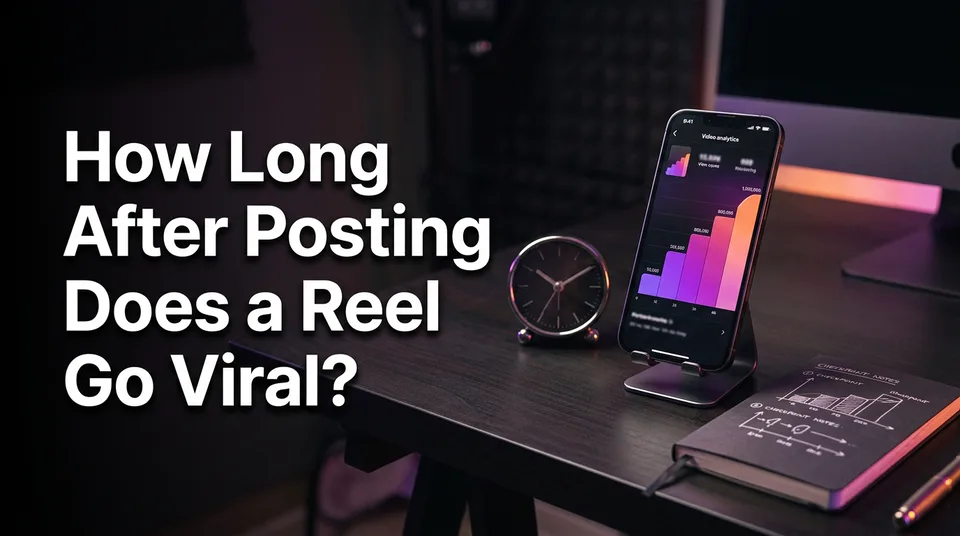
How Long After Posting Does a Reel Go Viral?
Reels don't go viral on a timer. Learn the three distribution waves, the signals that predict a push, and what to do at 1 hour, 24 hours, 72 hours and 7 days.
In this article
There's no fixed answer to how long after posting a reel goes viral. Most Reels show their early signal within the first hours to 48 hours, but distribution comes in waves, and a Reel can take off days or even weeks later. No platform guarantees a timing, so anyone quoting you one number is guessing.
What you can do is learn the pattern, watch the right signals, and stop killing Reels that were still being tested.
The short answer: there is no fixed timing
A Reel can go viral after 2 hours, after 2 days, or after a month, and nobody outside the platform can predict which. You'll see articles claiming 90 minutes, or 2 to 3 days. Those are observed patterns on some accounts, not rules.
Here's the mechanism. The platform shows your Reel to a small test audience, measures how they react, and decides whether to widen the audience. That decision can repeat several times, with gaps in between. So "how long does it take" really means "how many rounds of testing does it pass, and when."
How Reel distribution comes in waves
Reel distribution usually runs in up to three waves: a small test, an expansion, and sometimes a late resurfacing. These are patterns we've seen across pages, not documented platform timers, so treat them as a map and not a schedule.
Wave 1: the first hours
The first wave is a small test, mostly your followers plus a thin slice of people who don't follow you. Early watch-through and shares decide whether the Reel gets pushed further. Many Reels that eventually do well show a hint here, but a quiet first hour doesn't doom anything.
Wave 2: 24 to 72 hours
The second wave widens the Reel to interest-based audiences, and views tend to arrive in steps, not as a smooth curve. Facebook Reels in particular can keep picking up distribution for several days. A Reel that looked dead at hour 6 sometimes jumps on day 2.
Wave 3: days or weeks later
The third wave is a late resurfacing, and you can't schedule it. It can come from a big account sharing the Reel, a trending audio, search, or the system simply retesting an older video with a new audience. It's rare enough that you shouldn't plan around it, and common enough that you shouldn't delete anything in a panic.
What your Reel views look like after 24 hours
A flat Reel at 24 hours is normal, and the number only means something next to your own average. There's no official threshold for "viral," so the honest answer to "is 1,000 views a lot?" is: compared to what?
- 1,000 views on a page that averages 150 is a clear win.
- 2,500 views on a page that averages 20,000 is a miss.
- 10,000 views is big for most small pages, and routine for large ones.
Our rule of thumb: take the median of your last 10 to 15 Reels. Anything around 3x that median deserves a closer look at what you did differently.
If views stop growing, the usual causes are a weak Reel hook, low watch-through, poor cover and post packaging, or an audience that's already seen the format too often. Work through a diagnosis checklist before blaming the algorithm.
Signals that a Reel is about to take off
The strongest early predictors are watch-through (also called completion rate) and shares, followed by saves and rewatches. Likes are the weakest signal, because they're cheap.
Open Meta Professional Mode insights or Meta Business Suite and look at the retention graph, not just total views. A graph that holds above roughly half the audience through the middle of the video, plus shares coming in during the first hours, is the pattern you want. A cliff in the first 3 seconds means the hook failed, and no amount of waiting fixes that.
Ranking details change, so check the official guidance now and then: Meta's creator resources and the Instagram creators hub both explain how Reels are recommended.
Can a Reel go viral days later?
Yes, a Reel can go viral days or weeks after posting, and it happens on every major platform. But timing differs by platform, and none of it is guaranteed.
- Facebook Reels: distribution often stretches across several days, so judge at 72 hours, not 6.
- Instagram Reels: the first test tends to be sharper, and many Reels settle early, though late surges still happen.
- TikTok: videos are shown in batches and can stall, then restart. YouTube Shorts can resurface long after posting too.
Cross-posting adds noise. The same clip can pull 500K views on one platform and 2K on another, because the audience, the recommendation system and the format norms differ. A weak result on one app says little about the clip itself.
What not to do while you wait
Don't delete a Reel because it looks flat, and don't repost it within days. Both moves throw away a test that may still be running, and a repost can split your own audience between two copies.
Skip these too:
- Editing the caption or cover again and again during the first 48 hours.
- Re-uploading the same file "to give it another chance."
- Pulling a Reel after a slow first hour.
And a separate warning: reposting someone else's clip without permission is not a timing issue, it's an originality and rights issue that can cost you reach and monetization.
What to do at each checkpoint
At each checkpoint, check one or two signals and take one action, which is often to do nothing. Here's the routine we'd run for a daily poster.
| Checkpoint | What to check | Action |
|---|---|---|
| 1 hour | Early shares, first-seconds retention | Reply to comments. Change nothing. |
| 24 hours | Views vs your median, retention graph | Strong: leave it alone. Flat: note where viewers drop off. Don't delete. |
| 72 hours | Shares, saves, are views still moving? | Moving: wait. Stalled: run a diagnosis and move on. |
| 7+ days | Final read, any late resurfacing | Log what worked. Reuse the format with a new clip, not the same video. |
Then fix the next Reel, not the last one. If retention fell off early, tighten the hook. In WowReveal, the AI Clipper pulls the strongest moments from a longer video, and animated captions help keep the first seconds readable on mute. A steady posting rhythm beats watching one Reel's counter.
Frequently asked questions
Is 10,000 views on a Reel considered viral?
There's no official line. 10,000 views is a big result for a page that normally gets a few hundred, and ordinary for a large page. Compare it to the median of your last 10 to 15 Reels.
Can a Reel go viral days after it was posted?
Yes. Distribution can come in waves, and a Reel can resurface days or even weeks later through shares, trends or a retest by the platform. It can't be predicted or guaranteed, so don't delete or repost during the testing window.
Are 2,500 views on a Reel good?
It depends on your baseline. If your usual Reel gets 300 views, 2,500 is a strong outlier worth studying. If you usually get 20,000, it means that Reel underperformed.
Where to go next
- What to Do After You Post a Reel to Boost Views — The natural next step: what to do in the hours after you hit publish.
- What Is Completion Rate on Reels and Shorts? — Explains watch-through, the strongest early signal discussed above.
- Why Is My Reel Not Getting Views? A Diagnosis Checklist — Use it when views have stalled and you need to find the cause.
- How to Make Your Reels Go Viral on Facebook: Signals, Tactics and Fixes — Facebook-specific signals and tactics for your next Reel.
- Content Calendar for Daily Reels and Shorts: A Weekly Posting Schedule — Consistent posting matters more than waiting on any single Reel.
Generate your reel right now
Paste a link to any video — WowReveal writes the story, voices it and adds captions, a headline and music. Ready for Reels, Shorts and TikTok.

No link? Upload a file
- 30 free credits
- No card needed
- Voiceover in 9 languages
- Failed jobs refunded