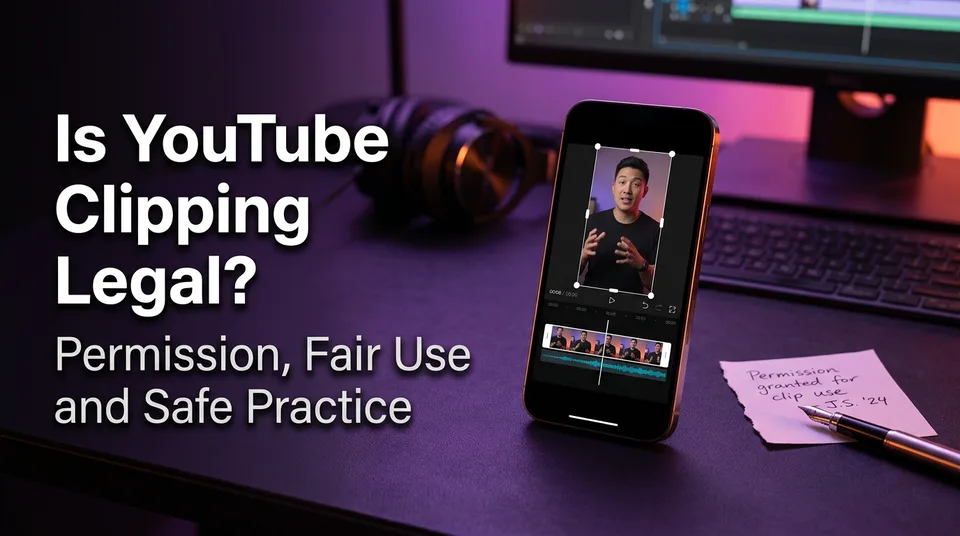
Is YouTube Clipping Legal? Permission, Fair Use and Safe Practice
Clipping someone else's YouTube video isn't automatically legal or illegal. Here's how permission, fair use and platform policy decide your real risk.
In this article
Clipping someone else's YouTube video is legal only when you have the owner's permission or a license, or when a case-specific fair use argument applies. Fair use is never guaranteed, so the safe route is clipping your own, licensed or explicitly permitted content and adding real commentary. This is general information, not legal advice.
Short answer: is YouTube clipping legal?
Clipping is not legal or illegal by default; the answer depends on who owns the footage and what you do with it. The act of cutting 30 seconds out of a video means nothing on its own. What matters is whether you had the right to use that footage.
Being able to watch, download or embed a video is not permission to re-upload it. We see this mix-up constantly: a creator assumes that "it's public on YouTube" means "it's free to post on Facebook Reels." It doesn't.
Three things decide your position:
- Do you own the footage, or have a license or written permission?
- If not, does a fair use argument hold for your specific clip?
- Even if the law is on your side, will the platform's reused-content rules still limit you?
The rest of this article takes those in order.
Why permission or a license is the safe route
Written permission or a license from the rights holder is the safest way to clip, because it removes the legal question entirely. Without it, you're relying on arguments, and arguments can be disputed.
A Creative Commons license can count as permission, but only within its terms. Some versions require credit, some forbid commercial use. Read the exact license, not the label.
How to get permission (and keep proof)
Ask the channel owner by email or a direct message, and say exactly what you plan to do: which videos, which platforms, whether you'll earn from the posts. Get a "yes" in writing and screenshot it.
Save the message with the date and the video links. If a claim ever lands, that thread is your evidence. A verbal okay on a call is worth very little a year later.
Clipping streams and streamers
Clipping streams follows the same rule: the streamer or the rights holder decides, not the clipper. Many streamers welcome clips, and some run official clipping programs with posted terms. Others don't allow reposts at all.
Watch for what's inside the stream, too. Game footage, background music and other people's videos can carry separate rights. A streamer saying yes doesn't always cover the song playing behind them.
Paid clipping gigs still depend on the creator owning what you cut. Confirm the terms before you start, and disclose paid promotion where the rules require it.
Fair use: a case-by-case defense, not a guarantee
Fair use is a legal defense that a court weighs after the fact, not a right you can switch on with a label. It's also a US doctrine; other countries have narrower exceptions, so the same clip can be judged differently depending on where you are.
YouTube explains how it treats the concept in its fair use help page, and the US Copyright Office gives the legal detail. Both say the same thing in different words: there's no safe percentage and no magic formula.
The four factors courts weigh
Courts look at four things together:
- Purpose: commentary, criticism, news reporting or transformation help. Pure re-posting for views doesn't.
- Nature of the work: factual material gets more room than highly creative work.
- Amount used: less is generally better, but even a short clip can be too much if it's the heart of the work.
- Market effect: if your clip substitutes for the original, you're in trouble.
Notice the first factor. Adding your voice, analysis or criticism over the clip is the difference between a defensible use and a repost.
What fair use does not mean
Writing "fair use" in the caption does nothing. Crediting the source doesn't fix it either. A 10-second limit isn't a rule. And "I'm not earning much" is not a defense.
Can you get sued for clipping? It's possible, though rare. Far more common outcomes are a Content ID claim, a DMCA takedown or a copyright strike. We can't tell you your odds, and anyone who gives you a confident percentage is guessing.
Legal risk vs platform risk
Legal risk and platform risk are two separate problems, and most clippers only think about the first one. Legal risk is a claim, takedown or lawsuit from the owner. Platform risk is the platform limiting your reach or income under its own rules, even when nobody files a claim.
| Legal risk | Platform risk | |
|---|---|---|
| Who acts | Rights holder, courts | YouTube, Meta, TikTok |
| Typical outcome | Content ID claim, DMCA takedown, strike, rarely a lawsuit | Demonetization, reduced distribution, removed content |
| Triggered by | Using footage without rights | Little or no original contribution |
| Fixed by | Permission, license, valid fair use | Real commentary, editing, original story |
On YouTube, copyright strikes carry real consequences, and repeated strikes can lead to channel termination. Content ID claims are different: usually the owner takes the revenue rather than you receiving a strike.
Separately, the reused content policy on YouTube (inside the YouTube Partner Program), Facebook and TikTok can cut monetization or reach for pages that post clips with no meaningful original contribution. No copyright claim required. Platform rules change, so check the current policy text before you build a workflow on it.
On TikTok, clipping works the same way. Its own Stitch and Duet tools follow the original creator's settings, but downloading and re-posting someone's video is a different thing.
Can you monetize or earn from clipped videos?
You can earn from clips only when you have the rights and add enough original value, and even then nothing is guaranteed. Clip and monetize someone else's video without permission, and the likely result is that the owner takes the revenue or you get no income at all.
Does YouTube pay you for clipping videos? Not for reposting other people's footage with no real contribution. The YouTube Partner Program expects original work. YouTube Shorts made from unlicensed clips tend to be the first thing to go wrong.
Is it profitable? It can be, in a few ways: clipping your own long videos, working inside an official clipping program, or building commentary formats where your analysis is the product. But "clipping is easy money" is a claim we'd be careful about. Earnings are estimates, and the platforms decide eligibility.
A safe clipping practice checklist
The safest approach is a ladder: start at the top and only move down when you must. Each rung has a check you can run in about two minutes before you hit publish.
| Rung | What you clip | Two-minute check |
|---|---|---|
| 1 | Your own videos | Is any third-party music or footage inside it? |
| 2 | Licensed or permitted content | Do you have the license or written yes, and does it cover this platform and monetization? |
| 3 | Commentary-based fair use | Is your commentary the point, and is the clip short and not a substitute for the original? |
| Avoid | Movie, TV, music and unlicensed stream clips | Skip them |
Rung 3 is the weakest. It's an argument, not a permission, so treat it as an exception.
Movies and TV are the classic trap. People ask how to use movie clips on YouTube without copyright issues, and the honest answer is that studios police this heavily, so skipping them is cheaper than defending them.
A few habits that keep us out of trouble:
- Keep a folder with permissions and license links for every source.
- Add your own voice, analysis or story, not just captions.
- Check music separately from video.
- Don't try to dodge Content ID with crops, filters or speed changes. It's against the rules and it doesn't change who owns the footage.
Clipping tools such as WowReveal AI Clipper or Opus Clip find the best moments fast, but they don't grant rights. The tool saves editing time; permission is still your job. Pointing one at your own long videos or a licensed library is the easy, defensible use.
If the stakes are high, say a large page, brand deals or a dispute, check local law or talk to a lawyer.
Frequently asked questions
Can I legally clip YouTube videos?
Only with the owner's permission or a license, or if a case-specific fair use defense holds. Fair use is never guaranteed, so clipping your own or explicitly permitted content is the safe route.
Does YouTube pay you for clipping videos?
Not for reposting other people's footage without meaningful original contribution. The YouTube Partner Program expects original work, and a Content ID claim usually sends the revenue to the owner.
Is clipping streams illegal?
Not automatically, but it depends on the streamer's or rights holder's permission. Some streamers run official clipping programs, others forbid reposts, and music or game footage in the stream can carry separate rights.
Where to go next
- What Is Reused Content on YouTube? Meaning, Examples and What Counts as Original — defines the term that decides whether your clips can earn.
- Reused Content Policies Compared: Facebook, YouTube and TikTok — the platform-risk side in detail for all three platforms.
- Repurposing Long Video into Shorts: The Complete Workflow — the legal-by-default route: clipping your own long video.
- Copyright and Music Rules for Reels and Shorts: What You Can Use and What to Do After a Claim — covers claims and music inside clips, a common cause of problems.
- Monetization-Safe Shorts: A Pre-Publish Checklist for Every Reel and Short — a final check to run after you clip.
Generate your reel right now
Paste a link to a long video — AI finds the best moments and turns them into ready Shorts with captions.

No link? Upload a file
- 30 free credits
- No card needed
- Voiceover in 9 languages
- Failed jobs refunded