Talent Show Shorts: How to Clip the Best Moments (and Stay Rights-Safe)
Good talent show Shorts live on one peak moment and one clear right to use the footage. Here's the clip recipe, the rights check and the headline pattern.
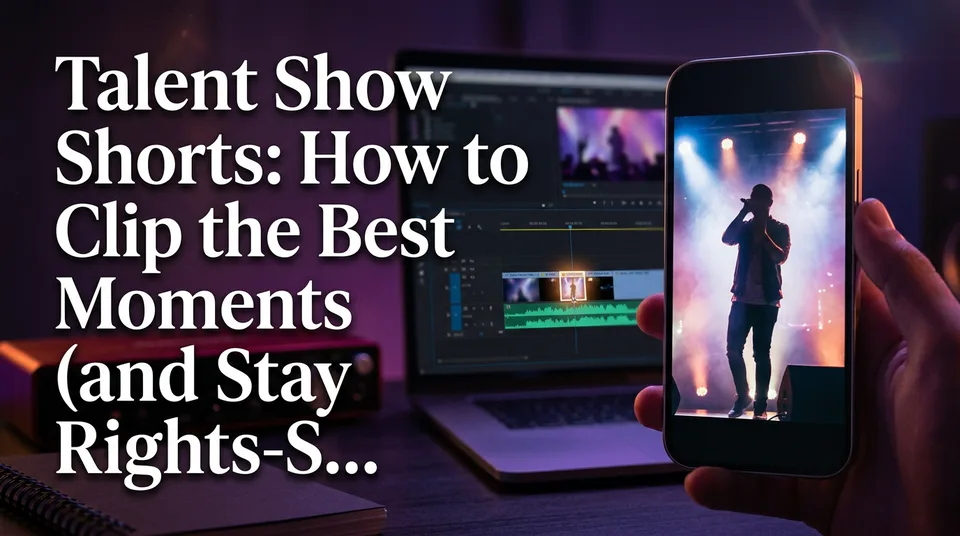
Good talent show Shorts clip one peak moment (the reveal, the buzzer, the reaction) with just enough setup, in roughly 20-45 seconds, and only from footage you own or have permission to use. Everything else, from captions to headline, is built around that single moment and that single right to post it.
Most pages get the first half right and skip the second. That's where reach and monetization quietly disappear.
What makes a talent show clip work as a Short
A talent show clip works as a Short because it delivers a complete emotional arc, doubt then payoff, in under 45 seconds. Viewers don't need the whole performance. They need the moment they'd text a friend about.
Search "talent show shorts" and you'll see the reference format. Official Got Talent channels on YouTube Shorts cut America's Got Talent auditions into tight vertical clips with a teaser title ("Is this for real??", "Don't Fall!"). The formula is simple: a performer who looks ordinary or at risk, a visible tension, a payoff, and a judge or crowd reaction.
Those channels own or license that footage. You probably don't. So you borrow the structure, not the clips.
How to clip talent show moments: choosing the peak and the context
You clip a talent moment by finding the single peak, then walking backward 3-8 seconds to capture only the context a stranger needs to feel it. Everything outside that window is a candidate for the bin.
Peaks are usually obvious on rewatch: the golden buzzer, the standing ovation, the trick landing, the shocked face of the judge, the moment a shy kid opens their mouth and sings. If you can't name the peak in five words, the clip isn't ready.
The 3-beat clip: setup, peak, reaction
Setup is the 3-8 seconds that answer "who is this and what are they about to try?" The peak is the act itself, the note, the landing, the reveal. The reaction is the crowd or judge response, held for a second or two longer than feels natural.
Cut long judge talk, walk-on delays and dead air. If the performer's intro is slow, start on the first action and let the headline carry the context.
Ideal clip length and where to cut
Aim for about 20-45 seconds, with the peak in the first 3-5 seconds or teased by your hook. If the real payoff lands at second 30, flash a half-second preview of it at the start, then rewind into the setup.
Cut on motion or sound, never mid-word. Export in 9:16 (1080×1920) so the same file works on Facebook Reels, TikTok, Instagram Reels and Shorts.
Kids' talent reels: what works and what to be careful with
Kids' talent reels work because sincerity and surprise travel well, but they carry the highest duty of care of any clip niche. Treat consent as step one, not a footnote.
Get written permission from a parent or guardian before posting any child performing. Don't expose full names, school names, addresses or live locations in the caption or on screen. Read each platform's policies on minors before you publish, because rules differ and change.
Keep the tone warm. Celebrate the effort, never mock a miss. A kid who freezes and gets encouraged can be a better clip than a flawless one, but only if the family is happy for it to be public.
Talent show clips and rights: what you can and cannot post
You can post talent show footage you own, have licensed, or have written permission to use. Broadcast show clips belong to producers and networks, and fair use is not a safe assumption. This is general guidance, not legal advice.
Own, licensed, permissioned or public-domain footage
Four sources are realistic for an independent page:
- Your own footage: school shows, community events, open mics, family talent nights you filmed yourself.
- Licensed footage: stock or library clips where the license explicitly covers social posting and edits.
- Permissioned footage: performers or event organizers who give you written approval, ideally with a note on credit and where you'll post.
- Public-domain footage: rare for modern performances, so verify the status rather than assuming.
YouTube's copyright basics explain why "I gave credit" or "it's only 30 seconds" isn't a permission. Meta's Business Help Center is the reference for Facebook content and monetization policies. Both can change, so recheck before you build a routine.
Why re-uploading TV clips is risky for monetization
Re-uploading a broadcast clip invites a copyright claim, removed reach, or loss of earnings on that video, and repeat problems can threaten the whole page's eligibility for Facebook content monetization or the YouTube Partner Program. We've watched pages lose weeks of reach after leaning on a single unoriginal source.
Adding captions on top of someone else's footage doesn't fix it. Transformation needs real originality, and a stranger's broadcast isn't yours to transform.
Writing a reaction headline and caption for clips
A good reaction headline states the stakes or emotion in a few words without spoiling the payoff or promising something the clip doesn't deliver. The caption then adds context and credits the performer or source.
Headline patterns that work
- Stakes: "One shot to land this trick"
- Reaction: "Nobody expected this ending"
- Contrast: "He looked nervous. Then he opened his mouth."
- Question: "How is she doing this?"
Put it on screen as short animated captions plus a headline, and pick a cover frame with the performer's face or the peak moment, clearly visible.
What to avoid: spoilers, fake claims, clickbait
Don't name the winner in the headline, claim "banned from TV" or "judges walked out" unless true, or label a local kid's show as a big-network audition. Misleading framing kills retention fast and can trigger platform action.
In the caption, credit the performer and the source: "Performed at [event], shared with permission." It builds trust, and it's evidence if anyone asks.
Is talent a good niche for Facebook Reels?
Talent is a good Facebook Reels niche when you have a legitimate footage source and can post consistently, but it's one of several repeatable niches and no earnings are guaranteed. Originality, retention and rights decide how it goes, and Meta decides eligibility.
Its strengths are broad emotional appeal, no language barrier and a clear hook structure. Its weakness is sourcing: pages that rely on borrowed broadcast clips are building on sand. If you're also weighing animal rescue, satisfying restorations or street food, compare how easy it is to get footage you're actually allowed to use.
On the other PAA question, good ideas for a talent show, the same logic applies in reverse: acts with a visible build and a clear payoff, like balancing, magic reveals, kid singers and unusual instruments, also make the best shorts.
A simple workflow to make talent Shorts faster
The fastest workflow is to confirm rights first, let AI find the peak, then polish captions and cover. Rights come before editing every time.
- Confirm the source: own, licensed or permissioned, with parent consent for kids.
- Run the clip: upload the long video to WowReveal and let the AI Clipper surface candidate peaks. Check them by eye.
- Apply the template: the WowReveal talent show template (or the kids' talent template) adds animated captions, a headline, music and a cover in 9:16.
- Write the post: reaction headline, a caption with credit, and hashtags.
- Check before publishing: originality, rights, no personal details on kids.
Review every clip manually. AI proposes, you decide.
Frequently asked questions
Which Shorts go viral on YouTube?
No format is guaranteed, but short clips with a fast hook, clear tension and a strong payoff tend to hold viewers to the end. That's the pattern behind most talent clips, and retention matters more than any single trick.
How long should a talent show Short be?
About 20-45 seconds works for most clips: 3-8 seconds of setup, the peak, and a brief reaction. Put the peak in the first 3-5 seconds or tease it in the hook.
Can I post America's Got Talent clips on my page?
Not without permission. Broadcast clips belong to the producers and networks, and re-uploading can bring copyright claims or lost monetization. Use footage you own, license or have written permission for.
Where to go next
- What Is Best-Moment Clipping? Definition, Scoring and Clip Length — understand how peak moments get picked and how long clips should be.
- AI Video Clipper: How It Finds the Best Moments in Long Videos — see how the tool automates the peak search.
- What Is a Niche Template for Shorts? — turn this format into a repeatable routine.
- Hooks for Reels and Shorts: How to Win the First 3 Seconds — open on the peak or a tease.
- Monetization-Safe Shorts: A Pre-Publish Checklist for Every Reel and Short — run the rights and originality check before you post.
Turn any video into a ready-to-post Reel
Paste a link — WowReveal writes the story, voices it in 9 languages and adds captions, a headline and music. Start with free credits, no card.
Start free →