What Is Best-Moment Clipping? Definition, Scoring and Clip Length
Best-moment clipping turns streams, podcasts and gameplay into short vertical clips. Here's the definition, a simple scoring checklist, clip length ranges and the mistake to avoid.
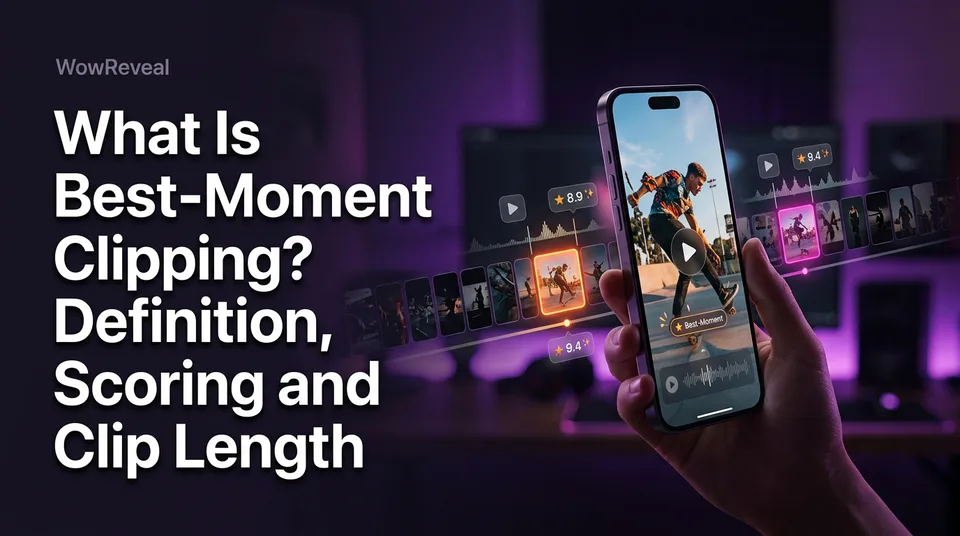
Best-moment clipping is selecting the strongest, self-contained segments from a longer video and cutting them into short vertical clips, typically 15-60 seconds, for Facebook Reels, YouTube Shorts, TikTok and Instagram Reels. Best moments clipping works on streams, podcasts, interviews, gameplay, talent shows, sports and event footage. The test is simple: would a stranger understand and enjoy the clip without seeing the original?
Key points
- A best moment has a strong hook, a payoff and enough context to stand alone.
- Most clips run about 15-60 seconds, but the payoff decides the length.
- AI finds candidates fast. A human should still approve the final cut.
- Game-capture tools record moments. Long-video clippers select and reformat them.
- Clip only footage you own or have rights to, and add something original.
Best-moment clipping: the short definition
Video clipping means cutting a short segment out of a longer recording. Best-moment clipping adds a ranking step: you judge the whole video, keep only the top segments, and export them as 9:16 vertical video (1080×1920).
Clipping vs. editing vs. repurposing
Clipping picks and trims. Editing reshapes pacing, sound and effects. Repurposing is the wider job of moving content to a new format. A finished Short uses all three, but selection comes first, because no edit rescues a dull segment.
What counts as a 'best moment' and how it is scored
A best moment is a segment that scores well on four things: hook strength, emotional or audio peaks, standalone context and payoff. Miss one badly and the clip usually underperforms.
Signals AI highlight detection looks for
Highlight detection typically scans for loudness spikes, laughter or applause, emphasized speech, sudden motion, scene changes and strong lines in the transcript. These are proxies. The AI can't know that an inside joke needs ten minutes of setup, which is why review matters.
A simple manual scoring checklist
Score each item 0-2, then keep clips scoring 6 or more out of 8. This is our own rule of thumb, not a platform metric.
- Hook: does something grab attention in the first 3 seconds?
- Peak: is there a clear emotional or audio high point?
- Context: does it make sense with zero background?
- Payoff: does it end on a resolution, punchline or reveal?
How long should a best-moment clip be?
Most best-moment clips work at about 15-60 seconds, and the payoff should set the exact length. A single-beat moment, like a reaction or a goal, can be 8-15 seconds. A mini-story with setup and reveal may need 45-60.
Cut right after the payoff lands. Platform maximum lengths change, so check the current limits in the help centers of Meta, YouTube, TikTok and Instagram before you build a routine around one number.
Game clipping tools vs. long-video clippers
To clip moments in games, use a capture tool that records in the background and saves the last few seconds on a hotkey. OBS does this with its replay buffer, and SteelSeries Moments and Medal do it with game detection. They capture. They don't judge or reformat.
Long-video clippers solve a different problem: you already have an hour of stream, podcast or event footage. Tools like OpusClip or the WowReveal AI Clipper propose candidate moments, crop to 9:16 and add animated captions.
So what's the best AI clipper for video? There's no single answer, and anyone claiming one is selling. Run the same 30-60 minute video through two tools and compare how many picks you'd actually post.
Looking for a SteelSeries Moments or Medal alternative? OBS is free for capture. For turning saved footage into Shorts, you need a clipper, and WowReveal gives free credits to start without a card.
The most common mistake: no context and no hook
The most common mistake is a clip that starts mid-scene with no hook and no context. Viewers swipe in the first 1-3 seconds, and "you had to be there" clips lose them.
The fix is mechanical. Start on the strongest line or action, even if that means trimming the lead-in. Then add a headline or caption that sets the scene in one line.
Where best-moment clipping fits in a Shorts workflow
Clipping is step two: source, clip, captions, headline, cover, post. We've seen pages skip the selection step and polish weak clips for an hour, which is backwards.
Rights come first. Only clip content you own or have permission to use, and add original value such as commentary, a voiceover or a real edit. YouTube's Partner Program policies cover reused content, and Meta and TikTok have their own originality rules. Unedited reposts risk demonetization. Rules change, and the platforms decide eligibility, never your clip.
Where to go next
- AI Video Clipper: How It Finds the Best Moments in Long Videos — the next step: how AI picks the moments defined here.
- AI Short Video Creation for Reels and Shorts: The Complete Guide — see where clipping sits in the full short-video workflow.
- Original Content on Facebook Reels: What Counts and What Doesn't — how clips stay original enough for monetization.
- Reused Content Policies Compared: Facebook, YouTube and TikTok — the rules around clipping existing footage.
- Monetization-Safe Shorts: A Pre-Publish Checklist for Every Reel and Short — a final check before you post clipped videos.
- Does YouTube Automatically Convert Videos to Shorts?
- AI Stream Clipper: How to Turn Podcasts and Streams into Shorts
- What Is a Compilation Short, and Is It Safe to Post?
Turn any video into a ready-to-post Reel
Paste a link — WowReveal writes the story, voices it in 9 languages and adds captions, a headline and music. Start with free credits, no card.
Start free →