What Is Limited Originality on Facebook? Meaning, Effects and Where to Check
Limited originality is Meta's flag for content your Page didn't really create. Here's what it means, what triggers it, what it changes, and where to see it.
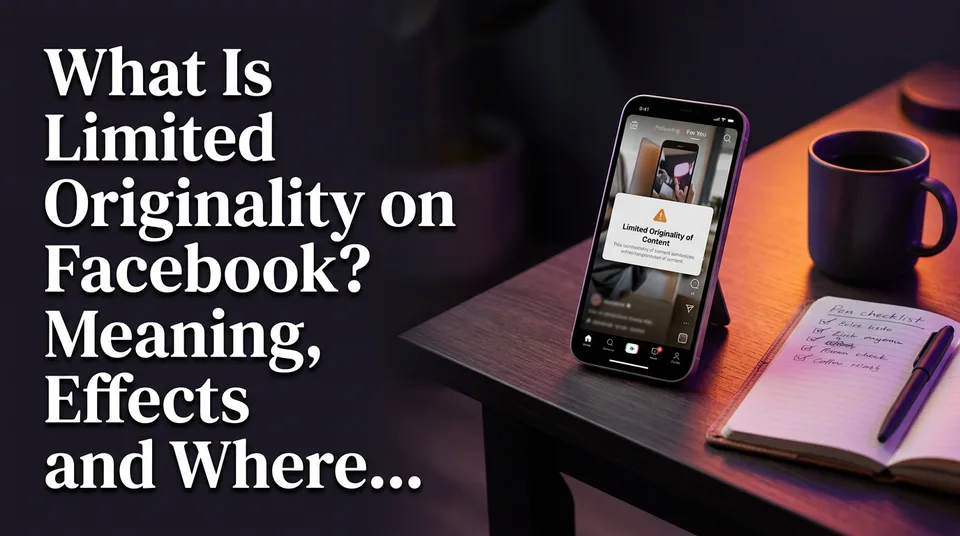
Limited originality is a Facebook policy flag applied when a Page or profile posts content it had no role in creating, or did not meaningfully change from its source. Meta responds with reduced distribution and possible loss of monetization eligibility. If you searched "limited originality facebook" after a notice appeared, that's the whole idea: Meta thinks your Page is mostly passing along someone else's work.
Key points
- It applies to Pages and profiles, and it's judged per piece of content and across the Page's overall pattern.
- The trigger is third-party content posted without substantial changes.
- The effects are reduced distribution and possible loss of Facebook content monetization eligibility or earnings.
- The status appears in Page quality or Account Quality and in the Support Inbox.
- Meta gives no guaranteed timeframe for recovery. Durations you read online are creator anecdote.
Limited originality: the short definition
Limited originality is Meta's label for unoriginal content, meaning anything your Page had no role in creating or didn't meaningfully alter from its source. Notices may read "Limited originality of content," and creators often call it an unoriginal content violation. The wording comes from Meta's Original Content Guidelines in the Meta Business Help Center, and rules like these can change.
What "original content" means to Meta
Original content is content you made or shaped yourself. That means footage you filmed, a script you wrote, a voice you recorded, or an edit with real creative decisions in it. Ownership of the upload isn't the test. Authorship is.
What "meaningfully alter" implies in practice
Meta doesn't publish a percentage or a checklist for "meaningful," so read it by what's cosmetic. A logo, a filter, a border, a speed change or a caption on someone else's clip is cosmetic. Your own commentary, a new story built over selected moments, and a fresh edit that makes a different piece are closer to transformation. We've watched pages treat a watermark as a fix, and it isn't one.
Examples: what gets flagged and what usually doesn't
The classic example of limited originality on Facebook is a viral clip from another Page, re-uploaded with your logo on it. Nobody outside Meta can promise how a given post will be judged, so treat the right column as "likely fine," not safe.
| Post type | Likely flagged | Likely fine |
|---|---|---|
| Viral clip | Re-uploaded with a logo, filter or caption added | Your own footage of a similar moment |
| Long video cut into Reels | Cut with no changes to the source | Permitted footage with your own script, narration and edit |
| Compilation | Other people's clips stacked under music | Cleared clips plus real original commentary |
| AI-assisted short | AI voiceover reading a scraped script over someone else's video | AI voiceover reading your own script over footage you own or have permission to use |
Reposting other people's videos without permission is the problem here, whatever tool you use.
What limited originality does to your Page
Limited originality reduces the distribution of the flagged content, and it can cost you Facebook Content Monetization eligibility or earnings. Meta states that unoriginal content gets reduced distribution, and its Transparency Center is the primary source for its distribution policies. In practice that means fewer people see your Facebook Reels, and a Page with a repeat pattern can be affected as a whole. Whether you keep or regain monetization is Meta's decision, and no one can promise an outcome.
Where to see the limited originality status
The status shows in Page quality or Account Quality, and in the Support Inbox on the Page or profile. In the Facebook app, look under the Page's professional dashboard or settings. In Meta Business Suite, check the Page's quality and support sections. Menu names move around between updates, so search for those terms rather than trusting a fixed path.
The Support Inbox usually names the flagged content and shows an appeal option where Meta offers one. Check it before you change anything.
How long it lasts and how people respond to it
Meta doesn't state a fixed duration for limited monetization or reduced distribution, so any number you read is anecdote. Creators report anything from days to months. That's folklore, not policy.
What Meta's guidance does say is simple: stop posting unoriginal content, and use the appeal option if it's offered and you really made the content. Keep your raw files, project exports and scripts as evidence. Some creators report deleting flagged posts or old reposts helped, but that's a reported tactic, not a promise, and it can't fix a Page whose whole feed is reused.
Prevention is cheaper than recovery. In our own workflow, the safest short is the one built on your own script and voice. WowReveal's story voiceover, captions and templates speed that up, but they can't make borrowed footage original.
Where to go next
- What Is Facebook Content Monetization? Definition, Eligible Content and How It Differs From Older Programs — the program whose eligibility this flag affects.
- Original Content on Facebook Reels: What Counts and What Doesn't — deeper rules on what Meta treats as original.
- Are AI Story Videos Allowed on Facebook and YouTube? — whether AI-made videos risk the flag.
- Reused Content Policies Compared: Facebook, YouTube and TikTok — how the same issue is handled on other platforms.
- Monetization-Safe Shorts: A Pre-Publish Checklist for Every Reel and Short — a practical check to run before posting.
- Why Facebook Says 'Criteria Not Met' for Content Monetization (and What to Check) — a related status message readers often confuse with this one.
- Best Niches for Facebook Reels: How to Choose One That Fits Your Page — pick a niche where you can make original content.
- How to Make Your Reels Go Viral on Facebook: Signals, Tactics and Fixes — grow reach once your content is clearly your own.
Turn any video into a ready-to-post Reel
Paste a link — WowReveal writes the story, voices it in 9 languages and adds captions, a headline and music. Start with free credits, no card.
Start free →