What Is Transformative Content? Definition and Examples for Reels and Shorts
Transformative content adds new meaning to source material instead of re-posting it. Here's what counts, what doesn't, and who decides on Reels, Shorts and TikTok.
In this article
Transformative content is content that adds new meaning, commentary, analysis or creative value to source material instead of just re-posting it. And the platform decides whether your video qualifies, not you. Meta, YouTube and TikTok each run their own checks, and a court judges it separately in a copyright dispute.
Key points
- Transformative means you changed what the material says or does, not just how it looks.
- It's a copyright idea (fair use) and a platform idea (originality rules). They aren't the same test.
- Credit, a "fair use" disclaimer, a filter or a music swap don't make a video transformative.
- Nobody can guarantee the outcome, including us.
Transformative content: the short definition
Transformative content gives viewers something the original doesn't. A new message, a critique, an explanation, a different purpose. If someone can watch your video and get nothing they couldn't get from the source, it isn't transformative.
In copyright law, "transformative use" is one factor in the fair use analysis. The U.S. Copyright Office describes fair use as a case-by-case judgment, not a checklist you can pass in advance.
Transformative vs reused content
Reused content is the platform-side opposite: material taken from elsewhere with little or no original contribution. Transformative is the goal, reused is the flag.
The two systems also fail differently. A copyright claim says a rights holder objects to your use. A reused content flag under the YouTube reused content policy says your channel adds too little original value, and it can cost you YouTube Partner Program eligibility even when no owner complains. We've watched pages lose reach for weeks after reposting one unoriginal clip, with no claim in sight.
Transformative video examples
The clearest examples change the purpose of the clip, not its packaging. Here's the split we use when reviewing short-form formats.
What counts
- Review: a 40-second Short that plays three seconds of a trailer at a time, then your own voice explains what works and what doesn't.
- Analysis: a Reel that pauses a sports play, draws the defender's path on screen and narrates why it broke down.
- Educational remix: a TikTok that cuts clips from several public talks into a new structure to teach one idea, with your own script tying it together.
In all three, the viewer learns or feels something because of what you added. That's why commentary and narration are the most common route.
What does not count
- Re-uploading a clip, even with a new title.
- A filter, crop, mirror flip or speed change.
- Swapping the music.
- Crediting the owner in the caption.
- Stacking five unedited clips with no point of view.
YouTube's own help page says plainly that giving credit doesn't by itself make a use fair. Writing "fair use" in the description is the same story: a disclaimer protects nothing.
Transformative use on YouTube, Facebook and TikTok
On every platform, transformation is judged by the platform's systems and reviewers, and rules change, so check the current wording. On YouTube, Shorts fall under the same YouTube reused content policy as long videos. On Meta, Facebook content monetization and the Facebook Reels originality rules reward original work and can restrict pages that mostly repost others' videos. TikTok applies its own originality and monetization requirements.
Legal fair use is a defense argued after a dispute. Platform policy is a gate checked before you earn. Winning the first doesn't open the second.
A quick test before you post
Ask one question: what did I add that a viewer can't get from the original? If the honest answer is "nothing, but it looks nicer," don't post it.
Run it as a short self-check:
- Is there new narration, commentary or analysis, in your voice or an AI voiceover you wrote?
- Did you change the structure, such as a different order, a point, an argument?
- Would the video still make sense if the original were removed?
- Do you have permission or rights for the source footage?
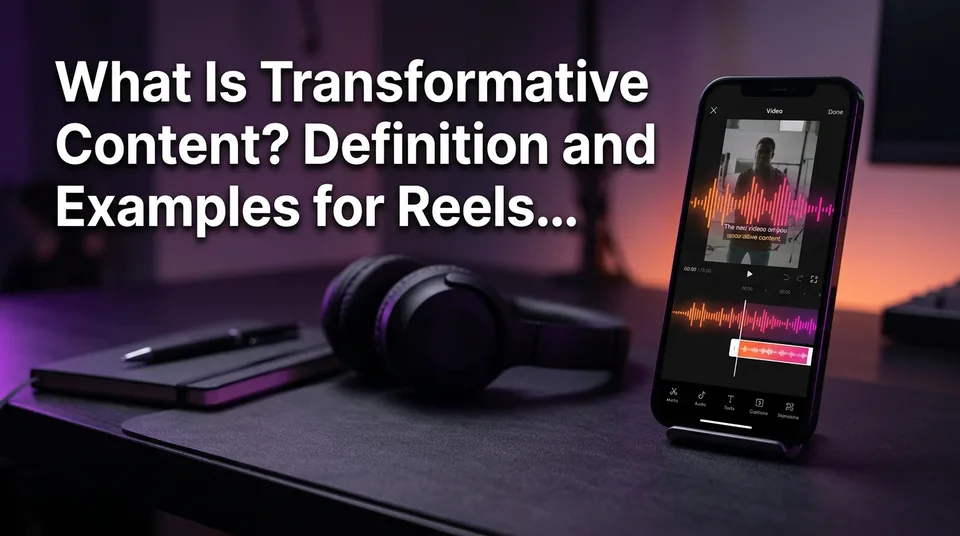
Tools help with the mechanics. WowReveal's story voiceover and animated captions, for instance, make adding your own script faster. But the script has to say something original, or the tool only speeds up a flag.
Where to go next
- What Is Reused Content on YouTube? Meaning, Examples and What Counts as Original — the opposite concept, and what actually gets flagged.
- Reused Content Rules: How to Stay Monetization-Safe on Every Platform — how the definition applies across platforms.
- Original Content on Facebook Reels: What Counts and What Doesn't — Facebook's side of originality for Reels page owners.
- YouTube Reused Content Policy 2026: What Changed and What to Check — current YouTube policy detail for Shorts.
- How to Put Commentary Over a Video (Voice and Text) — the most common way to transform a clip, step by step.
- Reused Content Checker: How to Self-Audit a Video Before Posting — turns the definition into a pre-post check.
- How to Fix a Reused Content Flag on YouTube — what to do if a video has already been flagged.
- Is AI Voiceover Allowed on Monetized Channels?
Generate your reel right now
Paste a link to any video — WowReveal writes the story, voices it and adds captions, a headline and music. Ready for Reels, Shorts and TikTok.
No link? Upload a file
- 30 free credits
- No card needed
- Voiceover in 9 languages
- Failed jobs refunded