What Is a Hook in Short Video? Definition, Types and Examples
A hook is the opening 1-3 seconds that gives viewers a reason to stay. Here's the plain definition, four types with examples, and how to test yours.
In this article
A hook in short video is the first 1-3 seconds of a Reel, Short or TikTok, the opening moment that gives the viewer a reason to keep watching instead of swiping away. It can be spoken, written on screen or purely visual. The best hooks combine at least two of those.
Key points
- A hook is a reason to stay, not a greeting or a title.
- "First 1-3 seconds" is a rule of thumb, not a platform rule.
- There are four common types: question, claim, visual surprise and open loop.
- A hook earns the first seconds. It doesn't guarantee people watch to the end.
- You check a hook in the retention graph, at the very start.
Hook definition: what it is in one sentence
A hook is the opening moment of a short video that gives the viewer a reason to keep watching. That's all it is.
Take a running example: a 30-second rescue story told with an AI voiceover. The hook is whatever happens before second 3. It might be the narrator's first line, a line of animated captions on screen, or the first frame itself. Most good ones use more than one at once.
Why the hook matters on Reels, Shorts and TikTok
The hook matters because every feed on Facebook Reels, YouTube Shorts, TikTok and Instagram Reels is one swipe from the next video. Viewers decide in a heartbeat, and your video competes with everything queued behind it.
Everything else you do, the story, the music, the payoff, only builds watch time if people get past the opening. We've seen well-made videos stall for one reason: nothing in the first two seconds gave anyone a reason to stay.
The 4 types of video hooks, with an example of each
Most hooks fall into four types: question, claim, visual surprise and open loop. Here is the same rescue story opened four ways.
Question hook
A question hook asks something the viewer wants answered. Example: "Why was this dog tied to a gate for three days?"
Claim hook
A claim hook states something bold or surprising that the video then backs up. Example: "Nobody thought this dog would ever walk again."
Visual surprise hook
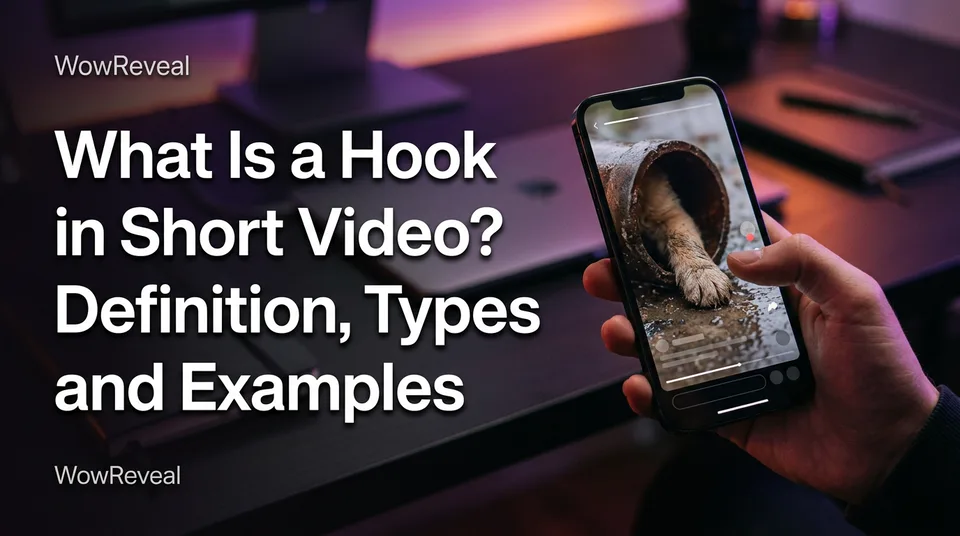
A visual surprise hook opens on an image that makes no sense yet. Example: the first frame shows a muddy paw sticking out of a drainpipe, with no explanation.
Open loop hook
An open loop hook promises a payoff and withholds it until later. Example: "By the end, you'll see what the rescuer found inside that pipe."
Hook vs intro: what is the difference?
A hook earns attention in seconds, while an intro introduces the topic, the channel or yourself. "Hi guys, welcome back to my page" is an intro. In shorts, you can usually skip it.
The same goes for the title and cover. They earn the stop or the tap in the feed. The hook earns the stay once the video starts playing. A strong cover with a weak first second still loses people fast.
How to tell if your hook works
A hook works if the early part of your retention graph doesn't collapse. Open the video's analytics and look at where viewers drop in the first seconds. YouTube's audience retention help page explains how to read those early drops.
Also look at the viewed-versus-swiped-away figure where the platform shows it. Metric names and screens change between platforms, so check what yours currently offers. One video is a weak signal. Compare several.
The most common mistake is a misleading hook. If the opening promises something the video never delivers, you lose viewers and their trust. A hook only works when the story pays it off.
Quick checklist for writing your first hook
You can write a usable hook in about a minute if you follow a few steps. No hook is "viral" on its own, so treat these as a way to test options.
- Write the payoff of your video in one sentence.
- Turn the most surprising part of it into a question, a claim or an open loop.
- Check the first frame. Does it show something, or just a logo or a black screen?
- Say it out loud. If it takes more than 3 seconds, cut words.
- Make a second version in a different type and compare retention.
A video hook generator can speed up step 2. WowReveal's script writer drafts several opening lines for a story, and you choose the one that fits what the video really delivers. Same idea for Shorts and TikTok: the 9:16 format doesn't change what a hook is.
Where to go next
- What Are Watch Time and Retention Rate on Short Videos? — the metrics you use to judge whether a hook is working.
- Story Structure for 30-Second Shorts: Hook, Turn, Payoff — shows where the hook sits in the whole story.
- What Is a Story Voiceover Short? Definition, Length and Example — the format behind the running example.
- How to Write a Short-Video Script with AI (Hook, Body, Payoff) — next step: write the hook as part of a full script.
- Short Video Retention: How to Get Reels and Shorts Watched to the End — what to do after the hook to keep people watching.
- AI Short Video Creation for Reels and Shorts: The Complete Guide — the broader workflow from idea to posted video.
- Niche Short-Video Formats: A Page Owner's Format Library — formats you can apply these hook types to.
- What Is Completion Rate on Reels and Shorts?
Generate your reel right now
Paste a link to any video — WowReveal writes the story, voices it and adds captions, a headline and music. Ready for Reels, Shorts and TikTok.
No link? Upload a file
- 30 free credits
- No card needed
- Voiceover in 9 languages
- Failed jobs refunded