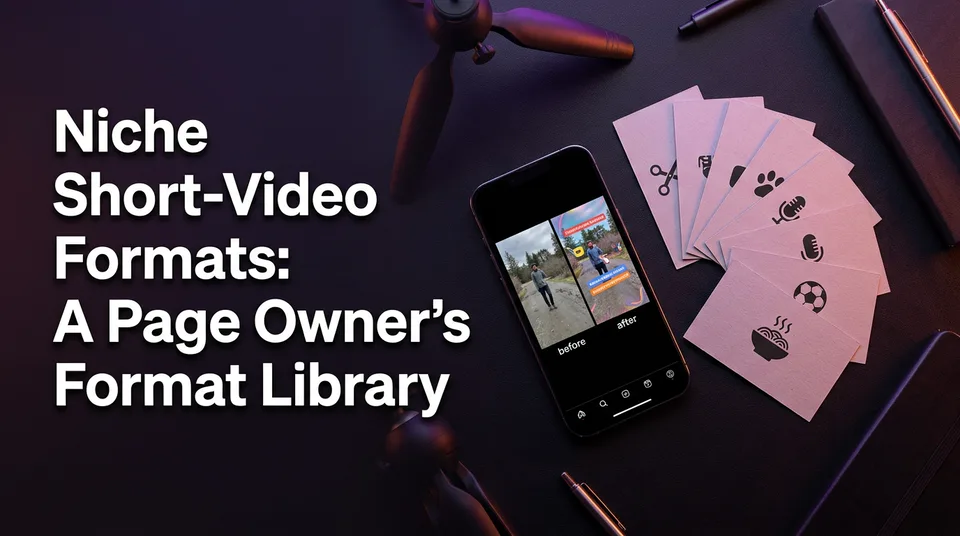
Niche Short-Video Formats: A Page Owner's Format Library
Stuck on what to post every day? Here are 10 niche short video formats with story structure, rights risks and effort levels, plus a method to pick yours.
In this article
The short videos you should make for your page are one repeatable format, such as transformations, rescues, talent moments, street food or podcast clips, chosen to fit your audience, your source material and your rights position, then posted in the same structure every day. This page is a library of those niche short video formats, with the story structure, pacing, rights risk and production effort of each.
We build tools that page owners use to make 9:16 Reels and Shorts daily, and one pattern shows up again and again. Pages that commit to a format ship more, fix problems faster and get better every week. Pages that chase this morning's trend rebuild the process every single day.
Key takeaways
- A niche is the subject (animals, haircuts, football). A format is the production recipe: hook, structure, pacing, voice and payoff. Pick the format first, because it's what you repeat.
- The library covers 10 formats: haircut transformations, satisfying restorations, animal rescue, wholesome kindness, talent shows, kids' talent, sports moments, best moments, street food and podcast clips.
- Score every candidate on five questions: audience fit, source-material supply, rights position, production effort and monetization fit. Then test 2-3 formats for 2 weeks before committing.
- Rights risk changes by format. Your own footage is safest, licensed footage is workable, and third-party clips need permission and real added value.
- No format guarantees views or income. Monetization depends on each platform's program rules and on whether your video is original.
- Copy a competitor's structure, never their clips, script or captions.
Niche vs format: what a repeatable short-video format actually is
A repeatable short-video format is a fixed production recipe you can run on new material every day, while a niche is only the topic area that material comes from. "Animal rescue" is a niche. "Cold open on the animal in trouble, three-beat rescue, warm payoff shot with a one-line captioned moral" is a format.
This distinction matters because most niche lists online rank subjects by trend or money potential. They never tell you what to actually produce at 9 a.m. on a Tuesday. A format does.
The five parts of a format recipe: hook, structure, pacing, voice/captions, payoff
Every format in this library is built from the same five parts. If you can write all five down on one card, you have a format. If you can't, you have a topic.
- Hook. The first 1-3 seconds. It states the tension or the promise: the matted dog, the 14-year-old with the microphone, the rusted tool nobody wanted.
- Structure. The order of beats. Before/after, problem/attempt/resolution, setup/punchline, claim/proof.
- Pacing. Cut length and rhythm. Restorations run on slow, satisfying detail. Sports moments run on fast cuts and a replay.
- Voice and captions. Who talks, in what tone, and how animated captions carry the message for viewers watching on mute.
- Payoff. The last beat that makes people watch to the end, and often rewatch: the reveal, the reunion, the final note.
Write these five lines per format and you've turned "what should I post?" into a checklist.
Why repeatable formats make daily posting possible
Repeatable formats make daily posting possible because they remove decisions. When the structure is fixed, each video is only a new input (a new dog, a new haircut, a new episode), not a new invention.
Viewers also learn the pattern. A returning viewer knows what the first 2 seconds of your video will promise, so they decide faster whether to stay. And for you, a stable recipe is the only thing that can be turned into a template and partly automated. We've seen page owners burn out on "creative" daily posting inside a month. The ones still posting a year later almost always run a recipe.
The format library at a glance
The library has 10 formats, and they differ most in two things: how risky the source material is, and how much work each video takes. This table is the quick reference. Later sections cover each format in more depth.
| Format | Story structure | Typical hook | Source material | Rights risk | Effort |
|---|---|---|---|---|---|
| Haircut transformations | Before, process cuts, reveal | "Nobody thought this could be fixed" | Own or partner barber footage | Low if you have consent | Medium |
| Satisfying restorations | Ruined object, key steps, finished result | "Watch this rusty tool come back" | Own or partner workshop footage | Low if own, higher if reposted | Medium |
| Animal rescue | Animal in trouble, rescue, recovery | "He was found like this" | Own, partner or licensed footage | Medium to high, plus ethics | Medium to high |
| Wholesome kindness | Situation, act of kindness, reaction | "She had no idea what was coming" | Own or licensed footage | Medium, plus consent | Medium |
| Talent shows | Nervous entry, performance, reaction | "The judges laughed. Then he sang." | Third-party show clips | High | Low to medium |
| Kids' talent | Small performer, surprising skill, applause | "He's 7. Wait for the second verse." | Own, parent-supplied or licensed | High (minors, privacy) | Medium |
| Sports moments | Setup, the play, replay and context | "Nobody saw this coming" | Broadcast footage or own match footage | Very high for broadcast | Medium |
| Best moments | Theme, ranked or timed clips, payoff | "The 3 funniest seconds of the week" | Long videos you own or have permission to cut | Depends on source | Low to medium |
| Street food | Ingredients, technique close-ups, final dish | "20 seconds to a perfect flip" | Own footage or partner vendor footage | Low if own | Medium |
| Podcast clips | Context line, strongest answer, takeaway | "He said what nobody admits" | Your own or licensed episodes | Low if you hold the rights | Low |
Two things stand out. The cheapest formats to produce (talent shows, sports) carry the highest rights risk. And the safest ones (own footage) cost you the most shooting time.
Transformation formats: haircuts, restorations and before/after
Transformation formats work because the whole video is a promise that the ending will look different from the beginning, and the viewer needs to see it. Haircut transformations and satisfying restorations share that skeleton: a clear "before" frame, a compressed process and a reveal held on screen for a full beat.
Haircut transformations
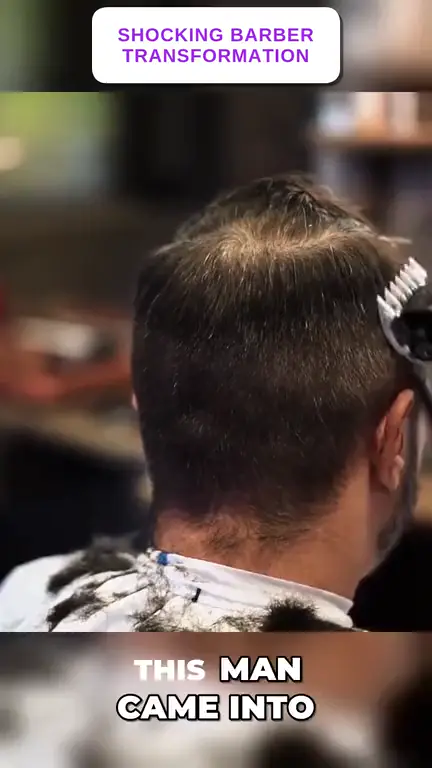
A haircut transformation is a before/after video with a 20-45 second process in between, ending on a held reveal shot. The hook is the "before": overgrown, uneven, or a style the client hated.
Structure: before shot (1-2 seconds), three to five quick process cuts (the first clipper pass, the line-up, the blend), then the reveal from the same angle as the opening frame. Matching the angle makes the change obvious. Pace the process cuts quickly and slow the reveal.
Source and rights: this is a format where your footage is realistic. Partner with a barber or salon, get the client's consent to appear and agree how the footage can be used. Downloading someone else's transformation reel and re-posting it is the fastest way to lose reach, and the platforms' originality rules are written for exactly that.
Effort is medium. Shooting is the bottleneck. Cutting, captions, headline and cover are fast with AI voiceover optional, since many of these videos work with music and captions alone.
Satisfying restorations
A satisfying restoration is a slow, texture-heavy video where a ruined object gets cleaned, repaired or rebuilt, ending on the finished piece. The hook is the state of the object: rust, mud, cracked glass, a flooded engine.
Structure: damaged object, three to six key stages, finished result with a rotating or locked-off final shot. The pacing is the opposite of sports. Longer holds on a pressure washer line or a sanding stroke are the point. Add sound design if you can, because the audio is half the satisfaction.
Rights risk is low if the footage is yours or from a workshop that gave you permission. It climbs fast if you stitch together restoration clips from other channels. A single long restoration video you made can be cut into several Shorts, and the AI Clipper is useful there for finding the best stages. Effort: medium, mostly in capture.
Rescue and kindness formats: animal rescue and wholesome stories
Rescue and kindness formats run on emotion and story arc, so they depend on pacing and on honesty about what actually happened. They also carry the most ethical weight of any format in the library.
Animal rescue
An animal rescue video follows a three-beat arc: the animal in trouble, the rescue, the recovery. The hook is the animal's condition in the first frame, and the payoff is the last shot, usually the animal safe, fed and calm.
Pacing matters more than people expect. Spend the first 20% of the runtime on the problem, 40% on the rescue and the rest on recovery. Pages that rush straight to the happy ending lose the tension that keeps people watching. A narrated story works well here because the narration can carry information the footage can't, like where the animal was found and what happened next.
Rights and ethics: use your own footage, footage from a rescue organization that has agreed in writing, or properly licensed material. Don't stage a rescue and present it as real. Don't use emotional framing to push donation requests you can't back up. Platforms have taken a hard line on staged and misleading animal content, and it's the right call.
Effort: medium to high if you shoot, medium if you partner and narrate. WowReveal niche templates include an animal rescue template that fixes the pacing and caption style so you only swap in the material.
Wholesome kindness
A wholesome kindness video shows a person in need, an act of generosity and the reaction, then ends on a short line that frames why it mattered. The hook is the situation: a stranger paying for groceries, a teacher surprised with a gift.
The reaction shot is the payoff, so hold it. Don't cut away at the first smile. Keep captions sparse and let faces do the work.
The risk is consent and authenticity. If you didn't film it, you need permission or a license. If it's re-enacted, say so in the description. Viewers and platforms both punish content that pretends staging is reality. Effort is medium, and it's a good format for story voiceover because a short narrated setup gives the clip its context.
Talent and moment formats: talent shows, kids' talent, sports and best moments
Talent and moment formats are the highest-risk group in the library, because their natural source material is somebody else's footage. They're popular for the same reason: the moments are already dramatic.
Talent shows and kids' talent
A talent moment follows a fixed arc: low expectations, the performance starts, the room changes. The hook is the contrast, such as a nervous entrance or a skeptical judge. The payoff is the reaction as much as the performance.
The structure is easy to copy and the footage is hard to clear. Broadcast talent shows are owned by networks and production companies, and Content ID (YouTube's automated rights-matching system) is very good at catching their clips. Re-uploading a segment with captions on top is not making something original.
Your safer options:
- Run your own talent showcase, such as local performers, school events you're invited to film or open-mic nights, with written permission.
- License footage from a rights holder who allows reuse.
- Cover talent as commentary, where you add analysis, context or a critique and use only what you need.
Kids' talent adds a second layer. Children's privacy and safety are not a gray area: get a parent or guardian's consent, don't share identifying details and don't use footage of minors you can't trace to a permission. We'd put this at the top of the "be careful" list. Effort is low to medium, but only after the rights work is done.
Sports moments
Sports moments are fast: the setup (score, stakes, time left), the play and a replay with context. The hook names the stakes in the first second. The play itself should land by second 5-8, then the replay from a second angle gives the payoff.
Broadcast sports footage is among the most aggressively protected material online. Leagues and broadcasters enforce hard, and "it's only 15 seconds" is not a defense we'd rely on. What works instead is your own match footage (youth leagues, local clubs, with permission), licensed clips, or original analysis built around graphics, stats and your own voice.
Effort is medium. The edit is quick, but building something original around the moment, like a tactical breakdown or a story about the player, is where the actual work goes.
Best-moments compilations
A best-moments compilation collects 3-7 highlights around a theme and orders them for escalating payoff. The hook is the theme or the ranking, and the last clip should be the strongest one.
The risk depends entirely on whose clips they are. Compilations of your own long videos, such as your podcast, your streams or your events, are fine and a very efficient use of material. Compilations of other people's viral clips are the classic way to get flagged for unoriginal content. Compilations need a reason to exist beyond collecting: your own selection logic, commentary or a new story.
For long videos you own, the AI Clipper scans for high-energy moments so you aren't scrubbing a timeline for an hour. Effort is low to medium.
Food and podcast formats: street food and podcast clips
Food and podcast formats are the two best fits for people with a steady supply of original material, because the camera is pointed at something you control. One is visual, the other is spoken, and both fit a daily schedule.
Street food
A street food video follows ingredients, hands and technique, and ends on the finished dish. The hook is the skill or the speed: a flip, a pour, a stack. The pacing is rhythmic, with cuts on action, close-ups on texture and sound.
This is among the few visual formats where the footage is easy to own. Walk up, ask the vendor, film. Get a clear yes before posting, and credit the vendor if they want it. Don't re-post other creators' street food videos with new music.
Faceless is easy here: the hands and the food are the subject, and a short voiceover or captions can add the where and why. Effort is medium, with filming as the main cost and captions, headline, music and cover as the quick part.
Podcast clips with the AI Clipper
A podcast clip pulls one strong 30-60 second moment from a long conversation, adds a context line at the start and ends on the takeaway. The hook is the boldest sentence of the clip, placed first in text or audio.
The rights position is the cleanest of the whole library if the show is yours or you have written permission. It's also the lowest effort. The AI Clipper reads a long video, finds the standout moments, and WowReveal then adds animated captions, a headline, a cover and renders the 9:16 file. Captions are not optional here, since a talking-head clip with no visual change lives or dies on text.
The common failure is clipping the middle of an answer with no setup. Always start with the question or a context line, then the answer.
How to choose a format for your page
Choose the format that scores best on five practical questions, not the one with the best-looking niche list. A format you can supply, clear and produce daily beats a "hot" one you can't sustain for a month.
Five scoring questions: audience, source supply, rights, effort, monetization fit
Score each candidate format 1-5 on each question, then add it up.
| Question | What you're really asking | Score 1 means | Score 5 means |
|---|---|---|---|
| Audience fit | Will your existing or target viewers care? | Nobody you know watches this | Your audience already engages with it |
| Source supply | Can you get new material every day for 3 months? | You have one good source | A steady stream you control |
| Rights position | Can you prove you're allowed to use it? | Third-party clips, no permission | Your own footage or written permission |
| Production effort | Can you finish a video in your time budget? | Hours per video | Under 30 minutes per video |
| Monetization fit | Does the format suit the program rules you're aiming for? | Likely to be flagged as reused | Clearly original and policy-friendly |
For monetization fit, read the official rules rather than a forum summary. Meta's Business Help Center is the starting point for Facebook content monetization requirements and originality guidance, and YouTube's Partner Program overview lists eligibility for the YouTube Partner Program. Both change over time, so check the current pages before you commit to a format.
Be honest on the rights row. It's the one people inflate.
Faceless-friendly formats and AI-voiceover formats
Faceless formats are the ones where the footage or the story carries the video, so you never need to appear on camera. Street food, restorations, animal rescue, best moments and podcast clips all work faceless. So do many haircut transformations, where hands and result are the focus.
AI voiceover (text-to-speech narration) fits best where the footage needs context it can't give itself: rescues, kindness stories, sports analysis and best-moments commentary. WowReveal writes a story and voices it in 9 languages, which helps page owners who aren't native English speakers and want to publish in more than one language. A script that's well written and a voice that's clear beat a fancy edit.
This is also where the question "which niche is best for YouTube Shorts?" gets an honest answer: the niche you can supply with original material, in a format you can repeat. Top faceless YouTube niche lists don't know your source supply. You do. If you want a place to start for ideas, a trend finder can show what's moving, but treat that as input, not a decision.
Test 2-3 formats for 2 weeks before committing
Test 2-3 formats for 2 weeks each at the same posting rhythm, then pick the one that wins on your own numbers. One week isn't enough. A single viral outlier can fool you in either direction.
A simple test plan:
- Pick the 2-3 formats with the highest scores from the table above.
- Post 10-14 videos per format, same length, same time of day, same quality bar.
- Track retention rate, share rate and follows per video, not just raw views.
- Drop the weakest format, keep the strongest and keep the middle one as a backup.
- Note which format was easiest to make, because that's the one you'll still be making in month six.
Originality and rights rules for each format
Originality means the video contains meaningful work that's yours, and rights means you're allowed to use every piece of footage and audio in it. Platform rules differ in wording but agree on the core idea: don't re-upload other people's content with minor changes and expect it to be treated as yours.
State rules loosely, because they move. Facebook's originality guidance and monetization policies sit in Meta's help center. YouTube's monetization policies cover reused and repetitious content. TikTok publishes its own originality requirements for its creator programs. Read all three for the platforms you use, and re-read them every few months.
What you add that makes a video yours: story, voiceover, structure, edit
What makes a video yours is creative contribution a viewer can identify: your own narration, your own story structure, your own selection and sequencing, your own analysis or your own footage. A caption and a filter are not enough.
In practice, that means you can answer "what did I add?" in one sentence:
- A written story and voiceover that explain the clip.
- A structure that changes how the material is ordered or paced.
- Commentary, context or analysis that wasn't in the source.
- Original footage you shot yourself.
If your answer is "I added music," it's not enough. That's also how we'd phrase it if you asked us to review your page.
Permission and licensing for third-party footage
Third-party footage needs permission from the rights holder, preferably in writing, and a license that covers your use. Without it, the safest assumption is that you can't use it.
| Source type | Typical rights position | What to keep |
|---|---|---|
| Your own footage | Strongest | Raw files, dates, release forms for people shown |
| Partner or commissioned footage | Strong if documented | Written agreement on reuse and credit |
| Licensed footage | Depends on license | The license, scope and duration |
| Third-party clips with permission | Workable | Written permission from the owner |
| Third-party clips without permission | Weak | Nothing protects you |
Don't try to dodge Content ID or originality checks with crops, mirrors or pitch shifts. It's against the point of the rules, it's unreliable and it can cost you the whole channel.
Compilations and monetization safety
Compilations are safe only when you have the right to every clip and the compilation has a reason to exist. A compilation of your own clips with a theme, a script and commentary is a legitimate format. A bundle of other people's viral clips is exactly what reused-content rules target.
We've watched pages lose reach for weeks after posting a handful of unoriginal compilations, then struggle to recover trust with the system. One shortcut isn't worth that.
The common mistake: copying a competitor's exact formula
The most common mistake in niche selection is cloning a competitor's formula: the same clips, the same script structure, the same caption style, sometimes the same title. It fails because you're always a step behind, and because near-duplicate content is exactly what originality systems are built to catch.
It also hides a trap. The competitor's results come from their audience, their source supply and their brand, none of which you copied.
Copy the structure, not the content
Copy the structure, not the content, means you borrow the skeleton (the hook type, the pacing, the payoff placement) and replace everything that makes it specific: the source, the story angle, the voice and the brand.
- Source: your own footage or your own licensed material, not theirs.
- Story angle: a different character, a different problem, a different lesson.
- Voice: your tone, your language, your narration style.
- Brand: your colors, your headline style, your cover. A brand kit keeps these consistent so people recognize you.
A rescue page that always opens on the animal's face is a structure. Another page opening on a face with the same dog, same story and same caption is a clone.
A quick differentiation test
Before posting, run this check:
- Could a viewer tell your video from theirs with the sound off?
- Is every clip in the video from a source you have rights to?
- Is the script your own, not a paraphrase of theirs?
- Would your hook still work if the other page didn't exist?
- Can you name one thing in the video that only you could have made?
If any answer is no, change that part before publishing.
Producing a format daily: templates, scripts and a brand kit
A format becomes sustainable when every repeatable step is templated and only the new material changes. That's the whole production secret. The goal isn't to make the process clever, it's to make it boring.
A daily workflow in five steps
Here's a workflow that works for most formats in this library:
- Source. Collect today's material: your footage, a long episode or a licensed clip. Check the rights note before anything else.
- Script. Use a script writer or a short template to draft a hook, body and payoff. For narrated formats, this is where the story is written.
- Clip or generate. Use the AI Clipper to find the best moments in a long video, or build from your own shots.
- Assemble. Add AI voiceover, animated captions, headline, music and cover, and render in 1080×1920 (9:16). A niche template holds these settings so you aren't rebuilding them.
- Package and post. Write the title, description and hashtags, schedule through Meta Business Suite for Facebook and Instagram, and log the post for review.
A realistic target: 20-40 minutes per video once the template exists. The first week will be slower. That's normal.
Scaling the same format across multiple pages
Scaling one format across several pages works only if each page has its own source, voice and brand. Running the same video on five pages isn't scaling, it's duplicating.
Agencies running many pages do best with a shared recipe and separate inputs: one template, different footage, different story angles, different brand kits and different posting windows. The recipe is reusable. The content has to be unique per page.
If you're managing pages for clients, document the format card (the five parts) and the rights log in one shared place. It saves arguments later.
Measuring whether a format works
A format works when viewers watch most of the video and come back for the next one, and that shows up in retention and repeat viewing before it shows up in income. Views alone can mislead you, because a single outlier can make a weak format look strong.
Retention and completion rate
Retention rate is the share of the video viewers watch, and completion rate is how many reach the end. Both tell you whether your structure holds attention. Check them per format, not per account.
Look at the retention curve, not only the average. A sharp drop in the first 3 seconds means the hook is wrong. A slow slide through the middle means the pacing is. A drop right before the payoff means you buried it. These are different fixes, and a format makes them easy to isolate because you change one part at a time.
On the "7 second rule on YouTube": we don't know of any official rule with that name in YouTube's documentation. People use it as shorthand for winning the first few seconds. The principle is fair, but treat the exact number as folk advice and check your own retention data.
Why view-count targets for income are unreliable
View-count targets for income are unreliable because earnings depend on far more than views. Program eligibility, country, audience, ad demand, content type and each platform's payout rules all change the outcome. RPM (revenue per 1,000 views) and CPM (cost per 1,000 ad impressions) vary widely between niches and between months.
So questions like "how many views do I need to make $3,000 a month?" or "to make $10,000?" don't have a trustworthy answer, and anyone who gives you a clean number is guessing. Nothing in this library guarantees income. Platforms decide eligibility and payouts.
What you can do is estimate. Use a calculator, such as WowReveal's free Facebook earnings calculator, and treat the output as a rough estimate to plan with, not a promise. Then watch your own retention, shares and follows. Those you can improve.
Frequently asked questions
What type of short videos should I make for my page?
Choose one repeatable format that fits your audience, your source material and your rights position, then post it in the same structure daily. Good starting points are haircut transformations, restorations, animal rescue, street food and podcast clips, because the source material can be your own.
Which niche is best for YouTube Shorts?
There's no single best niche, because the right one depends on what original material you can supply every day. Score candidates on audience fit, source supply, rights, effort and monetization fit, then test 2-3 formats for 2 weeks. Check current YouTube Partner Program rules before you commit.
How many views do you need on YouTube Shorts to make $10,000 or $3,000 a month?
Nobody can give a reliable number. Earnings depend on program eligibility, audience location, content type, ad demand and RPM, which all vary. Use an estimator for a rough planning figure, label it an estimate, and focus on retention and consistency.
What is the 7 second rule on YouTube?
We don't know of an official YouTube rule by that name. People use it as shorthand for hooking viewers in the first few seconds. The advice is sound, but check your own retention curve to see where viewers actually leave.
Which short video formats work without showing my face?
Street food, restorations, animal rescue, haircut transformations, best moments and podcast clips all work faceless. Use captions and an AI voiceover to add story and context. You still need the rights to every clip you use.
Can I use AI voiceover and still be eligible for monetization?
AI voiceover is a production tool, and eligibility depends on each platform's current rules, mainly originality and whether you have rights to the footage. A voiceover on top of someone else's clip doesn't make it original. Read the current Meta, YouTube and TikTok guidance, since rules change.
Is it safe to post compilations and sports or talent show clips?
Only if you have the rights to every clip and add real original value. Broadcast sports and talent show footage is heavily protected, and Content ID matches it quickly. Compilations of your own material, or of clips you have written permission for, are much safer.
How many formats should one page run?
Start with one, and test up to three for 2 weeks before choosing. Running many formats at once makes it hard to see what works. Once one format is stable, add a second only if it uses a similar workflow.
Where to go next
- What Is a Niche Template for Shorts? — Start here if you want the definition of a template before turning a format into one.
- Facebook Niche List: Categories Pages Commonly Use for Reels — A broader list of subject areas to pair with the formats in this library.
- Best Niches for Facebook Reels: How to Choose One That Fits Your Page — Deeper guidance on choosing a niche once you've picked your format.
- Niche Templates for Reels: Repeatable Formats for Daily Posting — The next step: turning your chosen format into a reusable daily template.
- Animal Rescue Reels: Format, Pacing and Rules — A detailed look at the rescue format, including pacing and rules.
- Can You Post AI or Repurposed Video on Facebook Without Breaking Originality Rules? — Go further on originality before you post repurposed or AI-assisted video.
- What Is a Compilation Short, and Is It Safe to Post? — Covers the best-moments format and its risks in detail.
- How to Write a Short-Video Script with AI (Hook, Body, Payoff) — Helps you write the script for each daily video.
- AI Story Video Generator: How to Turn a Story into a Short — Shows how narrated story formats like rescues and kindness videos get built.
- AI Video Clipper: How It Finds the Best Moments in Long Videos — Explains the mechanism behind podcast clips and best-moments formats.
- Short Video Retention: How to Get Reels and Shorts Watched to the End — Use it to judge whether a format actually holds attention.
- What Are Watch Time and Retention Rate on Short Videos? — Clarifies the metrics used in the measuring section.
- Short-Video Workflow for Agencies: Managing Many Reels and Shorts Pages — For scaling one format across many pages without duplicating content.
- Short-Form Video Monetization Across Platforms: Programs, Requirements and Rules Compared — Compare program rules before scoring monetization fit.
- AI Short Video Creation for Reels and Shorts: The Complete Guide — The wider guide to producing short video with AI across platforms.
- How to Grow a New Facebook Page with Reels: A 30-Day Plan
- How to Choose a Niche Template for Your Reels Page: A Decision Guide
- TikTok Creator Rewards vs Facebook Content Monetization: Which Fits Your Page?
Generate your reel right now
Paste a link to any video — WowReveal writes the story, voices it and adds captions, a headline and music. Ready for Reels, Shorts and TikTok.
No link? Upload a file
- 30 free credits
- No card needed
- Voiceover in 9 languages
- Failed jobs refunded